
Teach · 3 of 8
Water, Water, Everywhere
Water, and not a drop to drink
The background
What this theme sets out on water, and not a drop to drink, before any session.
This theme's background reading was rewritten by Swechha in September 2026 for Indian classrooms and in plainer language. The groundwater figures are the Central Ground Water Board's 2025 assessment and the Yamuna readings are CPCB's for 2025. India's own water history — the eri tanks, johads, tankas and stepwells — replaced a history that began in Persia and Egypt. Older figures the manual carried, including a decade-old set on cotton, were removed rather than restated.
In most Indian homes the water comes for an hour or two. Someone switches on the motor, the overhead tank fills, and for the rest of the day nobody thinks about water at all. This chapter is about the rest of the day.
1. BACKGROUND, CONTEXT & KNOWLEDGE:
Nothing on earth lives without water. It is inside everything that is alive, and it never stops moving between the sea, the sky and the ground. India gets most of its share in a few months of the year, from the monsoon, and then has to make it last until the next one.
For most of the last century the answer to needing more water was to build. Dams, canals, tube wells, pipelines. It worked, and it worked fast — more food needed more water, and India grew the food. What nobody costed was the water itself. In most of the country the limit on farming now is not land. It is water.
Some of what that cost is now visible. Rivers that run dry before they reach the sea. Wells that have to be deepened every few years. Water that is there and cannot be drunk. Water is not a separate thing from the land and the people around it — push hard on one part and the rest moves.
A river has always done several jobs at once. Drinking, washing, growing food, carrying boats, holding fish, taking waste away, and being the place people go on a festival morning. We ask a river to do all of that, and then judge it only by whether the water looks clean.
For a long time the demands were small enough that the river absorbed them. A village drawing water by hand, a few fields watered from a channel — the river carried it and recovered.
Then people began moving water to where they wanted it and holding it until they wanted it. Channels, bunds, tanks, dams. Every one of those is a decision about who gets water, and when.
India has been doing this for as long as anyone. The Harappan city of Dholavira, in Kutch, was built around its reservoirs. Tamil Nadu's eri tanks catch the rain and pass it down a chain of villages. Rajasthan has johads, tankas and step wells. Kerala has surangams cut sideways into hillsides. None of these were charity. They were the infrastructure a place needed in order to exist at all.
Many of them fell out of use when piped supply and borewells arrived. A tank nobody desilts fills with earth, and then with houses. Some survived because a community kept using them, and those are the ones worth taking a class to see.
At Patan in Gujarat there is a step well called Rani ki Vav, built by a queen in memory of her king. It goes down storey after carved storey until it reaches water. A society that builds its grandest monument in the shape of a staircase to the water table is telling you what it valued. It is on the back of the hundred-rupee note.
The modern answer was bigger. After independence India built dams on a scale it had never attempted — Bhakra on the Sutlej, Hirakud on the Mahanadi, Nagarjuna Sagar on the Krishna. Nehru called Bhakra "one of the temples of modern India", and to a country just out of famine that is exactly what a dam felt like.
Big was not always better. The Aral Sea, in Central Asia, has all but disappeared because the rivers feeding it were diverted to irrigate cotton — an entire sea, spent. Closer to home, the argument over the Narmada dams ran for decades and was never only about engineering. It was about who lost a village so that somebody else could have water. Large projects have also worked, and worked well. The useful question in a classroom is not whether dams are good or bad. It is who decided, and who paid.
India uses more groundwater than any country in the world, and almost none of it is visible. It sits under the field, under the street, under the school. The Central Ground Water Board measures it and publishes what it finds. Its 2025 assessment puts India's yearly draw at 247.18 billion cubic metres against 407.88 billion cubic metres that can safely be taken — a stage of extraction of 60.6 per cent. Stage of extraction is simply how much of the safe amount actually gets used. Sixty per cent sounds comfortable, and for the country as a whole it is. It is also an average, and averages are where trouble hides. The Board splits India into 6,762 assessment units, and around a quarter of them are Over-exploited, Critical or Semi-Critical. A unit covers a lot of ground, so a Safe block can still hold a colony whose handpumps have gone dry. And a low figure says nothing at all about whether the water is fit to drink. That is a different question, and this table does not answer it.
2. KEY THEMES AND QUESTIONS:
2.1 The ecosystem approach. An ecosystem is a place where living things and their surroundings act on each other. Nothing in it stands alone. Push one part and the others move, often in ways nobody predicted. The usual mistake is to manage for one thing only — flood control, or water quality, or crop yield — and then be surprised by what else changed. People use "ecosystem" and "environment" as though they meant the same thing. The difference is the difference between a house and a home. A house is something you stand outside and look at. A home is something you are inside. The ecosystem approach puts people inside.
This is not a new idea. Communities living off a river or a forest knew what could be taken and what had to be left, because the cost of getting it wrong landed on them within a season. Distance is what changed. When the water arrives through a pipe and the food arrives in a packet, the cost of getting it wrong lands somewhere else, on somebody else.
In short, the ecosystem approach means three things:
- Put the knowledge together first. Hydrology, biology, engineering, economics, law. A decision taken on any one of these alone is a decision taken half-blind.
- Treat people as part of the system, not merely as its users.
- Look at land, water, air and living things together, and over a whole catchment — the entire area that drains into one river.
It works at any size. At the largest it is the whole planet: a changing climate, pollution that travels, damage to the ozone layer. None of those stop at a state boundary.
Most of the time the useful unit is a river basin. India's are enormous — the Ganga, the Brahmaputra, the Godavari, the Krishna, the Narmada — and each one breaks down into smaller basins, and those into the stream behind your school. The approach is not only for rivers that are still clean. On a river under heavy pressure the aim is not to turn the clock back. It is to turn the trend around.
The Growing Concern for Water-Environmental Issues
Concern for the environment grew into a movement in the 1960s and 1970s, and it grew in India from the ground up. In the Garhwal hills, villagers put themselves between the trees and the axes. On the Narmada, whole valleys organised against their own displacement. Along the Ganga, priests and scientists ended up arguing the same case. What these had in common is that the people objecting were the people living with the consequence.
3. Why learn about water?
The United Nations has declared clean drinking water a human right, and says no other right is secure without it. Improving access to well-managed water is one of the Sustainable Development Goals:
SDG target 6.1: By 2030, achieve universal and equitable access to safe and affordable drinking water for all
Getting there is hard, and India is not a spectator. Here the water arrives for two hours and then stops. Or it arrives on a tanker and there is a queue. Or it does not arrive and somebody walks. Whether what arrives is safe to drink is a separate question again, and often nobody has tested it. This chapter is where to start: where water comes from, how it is measured, what the measurements mean, and what can be done.
The water cycle
The amount of water on Earth does not change. It moves — between the sea, the air and the land — and it changes form, between liquid, vapour and ice. That is the water cycle. Nothing is made and nothing is lost. The science of how water moves is called hydrology. The parts of the cycle worth knowing by name are evaporation, transpiration, condensation, precipitation, infiltration, run-off and discharge.
“Between earth and earth’s atmosphere, the amount of water remains constant; there is never a drop more, never a drop less. This is a story of circular infinity, of a planet birthing itself.” Linda Hogan, Northern Lights, 1990
How water moves and changes form
The sun drives all of it. Heat from the sun evaporates water from the sea and from every open surface on land — a pond, a flooded field, a bucket left out. Evaporation happens when water molecules take on enough energy to leave the liquid and become gas. That vapour rises. More comes from plants, which pull water up through their roots and release it through their leaves; that is transpiration. Evaporation from the soil and transpiration from plants together are called evapotranspiration. Wind carries the vapour until the air is cold enough for it to condense.
When water vapour condenses it makes cloud, which is nothing but very small drops of liquid water. If the air warms again the drops evaporate and the cloud disappears without rain. If it stays cold the drops bump into each other, join up, grow heavy and fall as rain, snow, sleet or hail. What falls on land does one of three things: drops straight into a lake or a tank, runs across the surface into channels and then rivers, or soaks in. Soaking in is called infiltration. Sooner or later all of it reaches the sea or goes back into the air, and the cycle runs again.
Climate, and why water is not spread evenly
Climate is the pattern of weather in a place over a long time. Weather is what happened today; climate is what usually happens. Climatology is the study of it — what the climate used to be, and what it is likely to become. Because the water cycle runs on heat and wind, a changing climate changes the water cycle. Rainfall and temperature in one place can differ sharply from one month, one year or one decade to the next.
India's seasons make this obvious. Most of the year's rain falls in the monsoon months, and much of that falls in a handful of heavy spells. The rest of the year is dry, and by May the evaporation is fierce. Flooding happens when a great deal of rain falls in a short time, or when above-normal rain keeps falling for weeks. A drought is the opposite — far less rain than normal, for months or years. Droughts usually bring water scarcity, which means there is not enough to go round for people, animals and the land.
What happens to a river when the rain stays below normal, or the heat above normal, for a long time?
How do you think anybody decides what a normal amount of rain is?
The cycle runs at different speeds in different places. It can rain in one village and not in the next. Rain is spread unevenly across the country and so are people, and the two do not line up. Cherrapunji is one of the wettest places on earth. Parts of western Rajasthan are among the driest. Both are India. That mismatch is most of what makes water hard to manage.
Everything above is the cycle left to itself. To understand real water supply you have to add what people do to it, which is the rest of this chapter.
How long does the water cycle take?
It depends where the water goes. Rain that falls on a beach is back in the sea in minutes. Water that soaks deep into rock, or freezes into a Himalayan glacier, can stay put for longer than a human life. The Ganga, the Indus and the Brahmaputra are all fed in part by ice that fell as snow a very long time ago. That store is now shrinking.
Geology
"Geo" means earth and "ology" means a body of knowledge, so geology is what we know about the Earth. Geologists study what the planet is made of and how it is put together. It matters here because rock decides almost everything about groundwater: where it can be stored, how fast it moves, how deep you have to drill, and what it picks up on the way.
3.3 The layers of the Earth
Most of the Earth is inner core, outer core and mantle, and it is hot — hot enough to melt rock. Geologists call melted rock molten. When a volcano erupts, that is molten material from below reaching the surface. The Earth is hot inside for three reasons: heat left over from when the planet formed; heat made by friction as material moves; and heat from chemical processes deep down. None of our groundwater comes from there. All of it sits in the crust, the outermost layer. If the Earth were a mango, the crust would be the skin — thin, next to everything under it. The crust is cool enough to be solid rock. Rocks are made of minerals, each with its own structure and its own mix of elements, and a single rock can hold many different ones.
3.4 Rock remembers water
Rock also decides what a borewell will find, and India's rock varies wildly. The Indo-Gangetic plain is sand and silt dumped by rivers over a very long time: soft, deep and generous with water. Much of peninsular India is Deccan basalt, hard rock left by old lava flows with almost no space inside it — there, water moves through cracks, and a borewell either meets a crack or brings up nothing worth having. Kerala and the Konkan have laterite. Rajasthan has sandstone and granite. The same depth of drilling means something completely different in each.
Layers of rock can be read like a sequence of events. Geologists from the University of Dschang and the University of Yaoundé did exactly that on a mountainside in Cameroon, in West Africa. Digging down, they found five layers: a thin skin of soil on top; under it loose volcanic rock thrown out by an eruption; under that sandstone made of coarse sand mixed with clay; under that a conglomerate of pebbles and cobbles set in sand; and at the bottom, solid rock formed when magma cooled.
Lowest means oldest. The rock at the bottom formed first, when molten material reached the surface and cooled.
Then water went to work on it. Pebbles and cobbles were washed down from the hills and buried the old rock. Those stones are heavy, so the water carrying them must have been fast and strong, and the fact that they are smooth and round means they were knocked about over many kilometres before they settled. The layer above is different: fine sand and tiny clay particles only. Particles that small settle out only where water is barely moving, or not moving at all. So the fast river had become a lake or a swamp. In time that silted up too, and there was no room left for water to stand there. A class can watch the short version of this after any heavy rain — gravel drops where the flow is quick, and the mud settles in the puddle that stops.
Above the sandstone came another eruption and another layer of volcanic rock, and above that the soil, made more recently out of weathered rock and dead plants. Five layers, and every one of them is an event. 4. Groundwater
4.1 How water gets into the ground
The top layer in most places is soil — rotting plant matter mixed with broken-down rock, the layer plants grow in. Under it are rock materials of different kinds. Think of the ground as two zones. The upper one, the unsaturated zone, holds some water but also air in the gaps between particles. Deeper down is the saturated zone, where every gap is full of water and the ground is holding all it can. The line between the two is the water table. When people say a well has gone deeper, what they mean is that the water table has dropped.
When rain falls on land, some of it soaks in. Some of that clings to soil particles and plant roots — this is soil moisture, and it is what a crop actually drinks. Some flows sideways through shallow ground and comes out in a stream; that is interflow. The rest keeps going down, crosses the water table and becomes groundwater. Adding to the store like this is called recharge. Groundwater is recharged by rain and snowmelt, by seepage from the beds of tanks, lakes and rivers, by leaking pipes and canals, and by the extra water poured on irrigated fields. A concreted city recharges very little, because the rain has nowhere to go in.
What is porosity?
Ground that looks solid is not. There is a surprising amount of empty space inside it, and that space is where water is stored. It comes in three kinds: the small gaps between the grains that make up rock or soil; the cracks in rock; and the channels that water itself dissolves out of limestone. How much space there is depends on the rock. The measure is called porosity — the share of a lump of rock or sediment that is empty.
Ground with high porosity can store more water than ground with low porosity.
In India, groundwater does more of the work than any other source. It is what the tube well in the field and the handpump in the lane are pulling on. It is only useful if you can get it out, though. Taking water out of the ground is called abstraction, and it works only if water can move through the rock to reach the well.
What is permeability?
Water can move through the ground only where the pore spaces and the cracks join up. Where they connect, water has a path.
Permeability measures how well those spaces connect. Laterite, the red rock under much of Kerala and the Konkan, is full of holes and passages and lets water through quickly. River sand does the same, which is why a well dug in an old river bed fills fast — and why sand mining costs a lot more than the sand.
Where the pores do not connect, permeability is low and water cannot move easily. Such materials are called impermeable. Clay and shale are made of very fine particles with plenty of tiny pores, but the pores are not joined up, so they stop groundwater or slow it right down. Solid basalt behaves the same way. It is why two borewells in the same village can give completely different answers: one found a crack, the other did not.
What is an aquifer?
Where the saturated zone can pass water through connected spaces, we call it an aquifer. An aquifer is groundwater you can actually take out — it yields water. How the rock layers are arranged decides how the water moves, and that gives two main kinds.
Unconfined aquifers. The top of an unconfined aquifer is the water table itself, usually not far below the surface. Rain soaks down through the unsaturated zone and recharges it directly. Below it lies a layer water struggles to cross — an aquitard slows water down, an aquiclude stops it. The water in an unconfined aquifer is at ordinary air pressure, so it has to be lifted: a bucket on a rope, a handpump, a motor.
Confined aquifers. These have a hard layer above as well as below, and they are usually deeper. The water in them is under pressure, from the weight of rock above and from water pushing in wherever the aquifer is recharged. Drill into one and the water climbs the borehole by itself, and sometimes flows out at the top. A well like that is called artesian, after Artois in France, where monks drilled the first one on record.
How is groundwater detected and assessed?
Hydrogeology is the study of groundwater and of the rock and soil it sits in. Hydrogeologists work out how much an aquifer holds, how fast it refills, and how much can be taken without running it down. They also track where pollution underground will travel, which is the only way to keep it out of a well. In India this work is done by the Central Ground Water Board and by the state groundwater departments.
The hard part is that you cannot see through the ground. Hydrogeologists start with what can be known from the surface — the rainfall, the geology, the records of nearby wells. Then they use geophysical methods, which measure the physical properties of rock from above, to map where water is likely to be and how it will move. Where the signs are good, a borehole is drilled to find out properly. A water diviner with a forked stick is not doing any of this.
Boreholes are also how water gets sampled. Knowing an aquifer holds water is half the job. The other half is finding out what is in it.
Is groundwater a sustainable resource?
It comes down to arithmetic. If an aquifer is reliably recharged and less is taken out than goes in, groundwater behaves like a renewable resource and can go on indefinitely. If more comes out than goes in, the store falls. That is over-abstraction, and it ends with the aquifer pumped dry.
This is what the Central Ground Water Board's stage of extraction is measuring. Above 100 per cent means a place is spending savings, not income. In the 2025 assessment Punjab takes out 156 litres for every 100 its aquifers put back. Rajasthan takes 147. Delhi takes 92 — under the line, and still no place to relax, because a figure under 100 says nothing about whether that water is fit to drink. Where recharge is slow, or has stopped altogether, groundwater has to be managed as something that will not come back: use less, waste less, put water back into the ground deliberately, and plan now for the year the well fails.
How can you grow crops without rain?
You pump. Across large parts of India the monsoon is not enough, or not reliable, and farming runs on water lifted out of the ground. Punjab grows paddy — a crop that wants standing water — in a state where it does not rain enough for paddy. The same trick is worked in the deserts of North Africa, where crops grow in vast circles watered from a pivot at the centre.
Some of the water being pumped in dry places is very old. It soaked into the ground when the climate there was completely different, and it has been sitting there ever since, cut off from rivers, lakes and the sea. Water like that is called paleowater. Nothing is refilling it.
That is the difference that matters. Water that is being refilled can be used year after year. Water that is not being refilled is a fixed quantity, and every litre taken is a litre that will not be replaced. Most real aquifers sit between the two, refilling at some rate — and the only question worth asking is whether that rate is slower than the pumping.
Think of it as money. Using groundwater that is recharged is like spending what you earn each month. Over-abstraction is spending your savings, and savings finish. Ask the class for a better comparison than this one. The good ones usually come from home.
5. Water quality. Water is a home for living things and it dissolves almost anything, so it picks things up the whole way round the cycle. Water quality is therefore never one fixed thing. It differs from place to place, and in the same place from season to season.
Three things are looked at when water quality is tested:
- Microbiology — bacteria, viruses, protozoa and worms.
- Chemistry — dissolved metals, other elements and chemicals.
- The senses — temperature, colour, smell, taste, and how cloudy it is.
The senses catch some things and miss the ones that matter most. Water can look clear, smell of nothing and taste fine, and still carry bacteria or arsenic. Almost everything that makes water unsafe can only be found by testing it, in a laboratory or with a field kit, and usually one test finds one thing — so a full picture takes many. Clear is not the same as clean.
Water quality standards
A test result on its own means nothing. It means something when you hold it against a standard. A water quality standard is the limit: how much of a substance, or how many organisms, may be present before the water counts as unsafe. Standards are written as concentrations — how much of a thing in how much water. Milligrams per litre is the usual unit.
Fluoride is a good example, and an Indian one. It occurs naturally in some rocks and dissolves into groundwater. A little is good for teeth. Too much damages them, and over years it weakens bone. The World Health Organisation advises that drinking water should carry no more than 1.5 milligrams of fluoride per litre. In parts of Rajasthan, Gujarat, Andhra Pradesh and Telangana, groundwater carries more than that, and what it does to the people drinking it has a name: fluorosis.
For some things there is no safe amount. The World Health Organisation advises that drinking water should contain no Escherichia coli at all — not one in 100 millilitres, which is about a small glass. E. coli in water is a signal that human or animal faeces have reached it, and where faeces have reached, so have the organisms that cause diarrhoea.
Most countries write their own standards from that guidance, and they write more than one set: for drinking, for bathing, for rivers, for keeping wildlife alive. India's are set by the Central Pollution Control Board, which also measures rivers against them. Take dissolved oxygen — the oxygen held in the water itself, which fish and everything else in a river need. The standard for water fit to bathe in is more than 5.0 milligrams per litre. Where the Yamuna comes out of the mountains at Yamunotri it carries 11.2. By the time it has crossed Delhi, at four monitoring stations one after another, the reading is 0.3 milligrams per litre — and 0.3 is simply the lowest figure the method can report, so the true value is that or below. The river arrives full of oxygen and leaves with none that anyone can measure.
Contamination and pollution
Most of what is dissolved or living in water is harmless, and some of it is good for you. But water can be polluted by what people do, or naturally contaminated by what it has passed through, and either can make it dangerous or make it taste foul.
Natural contamination. Water can carry pathogens spread by animals, which is more common in surface water than in groundwater because animals reach it more easily. Groundwater has better natural protection, which is not the same as being safe. Water dissolves elements out of rock, and some of them harm people. Arsenic is the sharpest example in India: across the Ganga and Brahmaputra plains, in West Bengal, Bihar, Assam and eastern Uttar Pradesh, tube wells drilled to escape dirty surface water brought up arsenic instead. It has no taste, no smell and no colour. The only way to know it is there is to test. Rock can also make water salty, which is why groundwater far from any sea can still taste of salt.
Pollution from people. There are many routes in. Some of the common ones:
- Sewage and solid waste that go nowhere — untreated drains running into a river, rubbish tipped on its bank, open defecation, cattle waste, a latrine built too close to a well.
- Fertiliser and pesticide used carelessly on fields, which the next rain carries into the stream or down into the aquifer.
- Industrial effluent let out untreated — dyeing, tanning, electroplating, distilling, paper.
- Bathing, washing and idol immersion in the water people also drink.
Where contamination cannot be avoided, the water has to be treated or brought from somewhere else. Treatment is also the only thing standing between a city's sewage and the river it sits on — when the plant has been built, and when it is switched on.
6. Water management
So far this chapter has been about how water moves on its own. People change all of it. We change the quality, by what we put in. We change the storage, by building dams and sinking wells. We change the direction, by cutting canals and laying pipes. And whenever water is taken out and used up rather than returned — by a crop, a factory, a household — there is less left in the lake, the reservoir or the ground than there was.
How much water do you use?
You may never have watered a crop or run a factory. You still use the water that did. What you eat, what you wear, the building you are sitting in and the road you came on — water went into every one of them.
Step on wet sand and you leave a footprint the size of your foot. Use water — by drinking and washing, and through everything you eat and buy — and you leave a water footprint. The more you use, directly and indirectly, the bigger it is. The Water Footprint Network splits it three ways. Green is rainwater held in the soil and taken up by plants. Blue is water drawn out of a river, a lake or an aquifer. Grey is the water it would take to dilute the pollution you caused until it met the standard. Everything carries its own. A kilo of rice in a shop carries the water used to grow the paddy, the water it would take to dilute the fertiliser and pesticide running off that field, the water used to make the packet, and the water burnt getting it to the shop. Your own footprint is the sum of everything you use.
Crops and products that need a great deal of water are called water intensive, and so are the industries that make them. Farming is the most water-intensive thing people do, anywhere. Paddy is thirsty; bajra, jowar and ragi, which this country grew for centuries, are not. Meat and dairy carry heavy footprints, because the animal drinks and the animal's feed has to be grown as well. Cloth is another: the cotton is grown, and then dyeing and finishing use water again and hand most of it back dirty.
Who makes decisions about how water is managed?
Governments write the policy and the law. Both exist to steer what people and companies are allowed to do with water, and regulators — government bodies with the power to enforce — are meant to check that the rules are kept. In India, water sits with the Ministry of Jal Shakti at the centre and with a water department in every state, while the Central Pollution Control Board and the state pollution control boards deal with what goes into it.
National law is often shaped from outside it. Governments refer to the United Nations' Sustainable Development Goals and to World Health Organisation guidance on drinking water. In a democracy it is also shaped by what voters push for, which is the opening this chapter is really about.
Scientists and engineers shape decisions too. Some do the research the policy is built on. Others design, build and run the thing itself — the treatment plant, the dam, the pipe network — or gather the data and file the reports that show whether the law is being kept.
Businesses decide how much water they take and how much pollution they let out. Some of that is fixed by law, and breaking it can mean a fine or a prosecution. Where the law is weak or nobody enforces it, a company decides for itself, and a factory that finds it cheaper to discharge than to treat will discharge until somebody makes it stop. Working out who that somebody is, for a river near your school, is a good exercise for a class.
Communities decide as well, and in rural India they decide a great deal. Where there is no piped network the supply is a handpump, a borewell, a tank or a small scheme, built by the government, by an organisation or by the village itself. A gram panchayat or a village water committee then has to run it. The hard part is never the building. It is the year after — who repairs the pump, who pays for the part, who keeps the key.
Managing water for sustainable agriculture
Growing food is what most water is for. From a kitchen garden to a large plantation, nothing grows without it. Where a lot is used, sustainability stops being an abstraction. Will the water be used faster than rain can replace it? Will fertiliser and pesticide run off this field into the stream? What can a farmer actually do to use less and pollute less? Those questions have answers.
Ways that farmers protect soil and conserve water
Big farm or small, the harvest rests on soil and water, so a farmer who means to keep farming protects both. What works depends on the soil and on when the rain comes, and it has to be adjusted as the climate shifts. Some of what is already being done in India:
- Terracing and bunding — low walls along the contour that stop soil washing away and hold rain where it falls, long enough for it to soak in.
- Farm ponds, johads and check dams that catch run-off instead of letting it leave, and recharge the ground under the field.
- Growing what the place can support — local varieties, and crops that need less water. Bajra, jowar and ragi were dryland staples long before anyone called them a trend.
- Compost and mulch. Dead plant matter laid on the surface, or rotted down and dug in, changes how soil handles water: it stops water standing on top and evaporating, it stops roots rotting in a waterlogged patch, and it lets water seep down at a rate plants can actually use. It is the cheapest improvement available to almost any farmer.
- Drip irrigation — pipes that deliver water to each plant's roots instead of flooding the field, so far less is lost to evaporation. Systems exist for small plots, and some schools run them. They only help if somebody keeps checking that they still work.
Using greywater on plants
Greywater is water the house has already used once — from bathing, washing and the kitchen. Put on plants, it gets a second life. Proper systems exist that filter, treat and store it, and they are worth costing before buying. The simplest version is a bucket: catch the water from rinsing vegetables or washing clothes and carry it to the garden. Read the safety points in the activities below before doing it. Water from the toilet is not greywater and must never be used this way.
Cotton, and the water India exports without noticing
The argument that follows was made by Stephen Leahy in the Guardian, on World Water Day 2015. His figures are a decade old and are not repeated here.
India is short of water, and cotton is one of the reasons. Almost nobody in the chain — the grower, the buyer, the government — behaves as though that is their problem.
When India exports cotton, it exports water. Not in the bale — in what it took to grow the bale. The same is true of everything else that leaves the country.
A crop watered from a falling water table, in a block that is already Over-exploited, sold abroad at a price that does not count the water: that is the shape of the problem. The water does not come back.
Virtual water
Cotton is not even India's biggest export — petroleum products, and gems and jewellery, are ahead of it. Every one of them takes water to make. It takes water to grow anything, and it takes water to make anything: cars, furniture, books, phones, buildings, jewellery, toys, and the electricity that runs the factory. Water you never see, inside things you buy, is called virtual water.
Virtual water is as real as the water in your glass. Once it has been used to make something it has either evaporated or come out too dirty to use again, and either way it is not available for anything else. A shirt is a few hundred grams of cotton and a quantity of water nobody will ever show you.
Add up a country's exports and you are adding up water it has sent away. It is a real transfer and it appears in no ledger. Nobody writes a bill for it, so nobody argues about the price.
Doing things differently
None of this is fixed. Cotton uses as much water as the way it is grown demands. Two things push India's use up: water is spent carelessly in the field, and a lot of what comes back is polluted, because cotton is among the most heavily sprayed crops there is.
Most of India's cotton grows in the drier parts of the country, watered by electric pumps on subsidised power, with no limit on how much groundwater may be drawn. If the electricity is nearly free and the water is entirely free, the only rational thing to do is pump. That is not a farmer's failure. It is the design of the system, and it strains the aquifer and the power grid at the same time.
This is the loop the chapter keeps coming back to, and the Central Ground Water Board's 2025 assessment is where you can watch it happen: Punjab at 156 litres taken for every 100 returned, Rajasthan at 147, and around a quarter of India's 6,762 assessment units already Over-exploited, Critical or Semi-Critical.
A falling water table is not a forecast. It is a measurement, taken every year, in a report anybody can read. The well in the village has been saying the same thing for longer, and with less punctuation: it used to be this deep, and now it is deeper.
The sessions
8 sessions for this theme. Take one, take all of them, or change them for your own room.
-
01
Vision for waterStudents pick two of the questions below and argue them out, in pairs or in small groups, using what they already…
-
02
Water cycle in a bag!The whole water cycle, in a plastic bag taped to a sunny window. Students watch evaporation and condensation happen…
-
03
My Water FootprintIntroduces two ideas: your water footprint, and the water hidden inside everything you buy.
-
04
Saving Water At HomeSession 4 of this theme.
-
05
Saving Water on CampusSession 5 of this theme.
-
06
The Ocean and Plastic PollutionSession 6 of this theme.
-
07
Gray, Green, Blue: Water SecurityWhat it takes to keep water running in a growing city, and who does that work — read off a set of photographs.
-
08
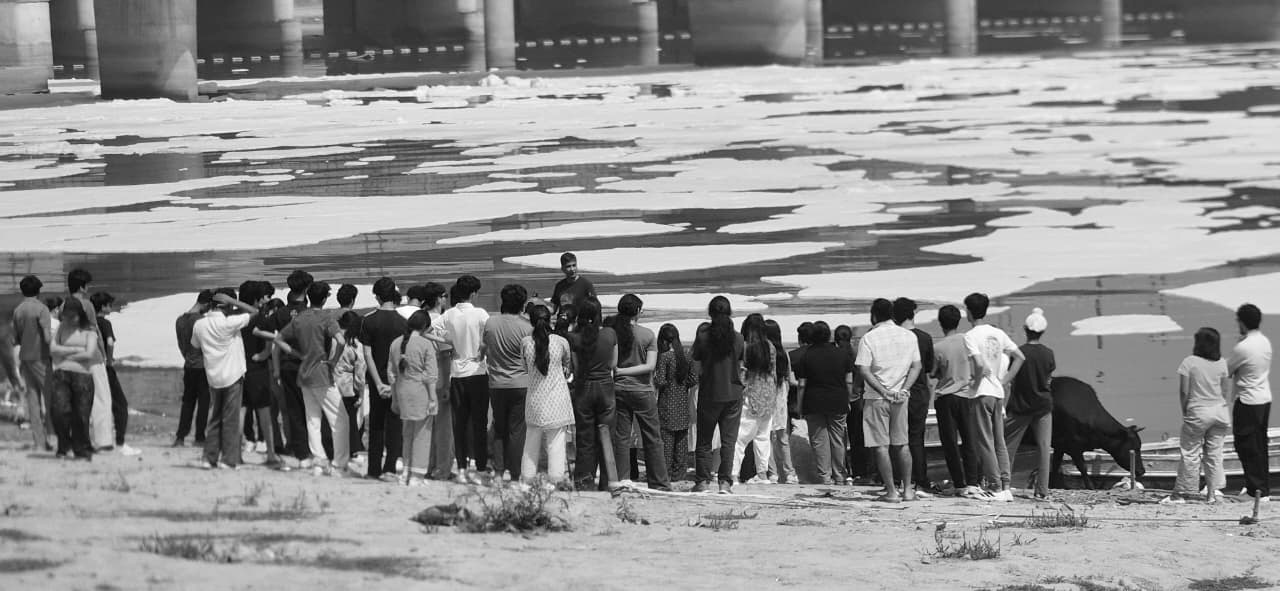
Exposure WalksTo follow the Yamuna through Delhi and work out, standing on the bank, what the city does to the river and what it…
Understand the data
The numbers behind this theme, as this site publishes them.
Understand the data
- Why is the Yamuna so polluted in Delhi?Twenty-two kilometres, most of the flow diverted, and the drains that replace it.
- What is BOD?The oxygen a sample will consume in five days — the standard measure of organic pollution.
- What is dissolved oxygen?The single measurement that decides whether anything can live in the water.
- What is faecal coliform?The measurement that decides whether water is safe to touch, and the one Delhi fails by a factor of six thousand.
- What is groundwater extraction?The other water, and the only one of Delhi's two that is still being spent faster than it returns.
Next
The other themes, and what to read first.
Start here
Before you startHow to teach this, and why it is taught this wayAll eight
Teach43 sessions across 8 themesLook a word up
The A to Z334 environmental terms, defined plainlyThe other themes
- Sustainable DevelopmentSustainable development · 11 sessions
- Blowing in the WindAir pollution and what it does to a body · 3 sessions
- Food on my PlateWhere food comes from · 3 sessions
- Future and EnergyEnergy and the future · 5 sessions
- Wasted!Waste, and what happens to it · 5 sessions
- Trees and ForestsTrees, forests and how they grow · 4 sessions
- Climate Justice and Active CitizenshipClimate justice and active citizenship · 4 sessions