
Yamuna & water
What is dissolved oxygen?
Dissolved oxygen is the amount of oxygen gas held in water, measured in milligrams per litre. Fish, invertebrates and the bacteria that break down waste all need it. India's bathing-water criterion is more than 5.0 mg/L. Four consecutive stations on the Delhi Yamuna report a 2025 minimum of 0.3 mg/L, which is the floor the measurement method reports — meaning at or below it.
Where the oxygen comes from, and where it goes
A river gains oxygen at the surface and loses it to whatever is decomposing in it.
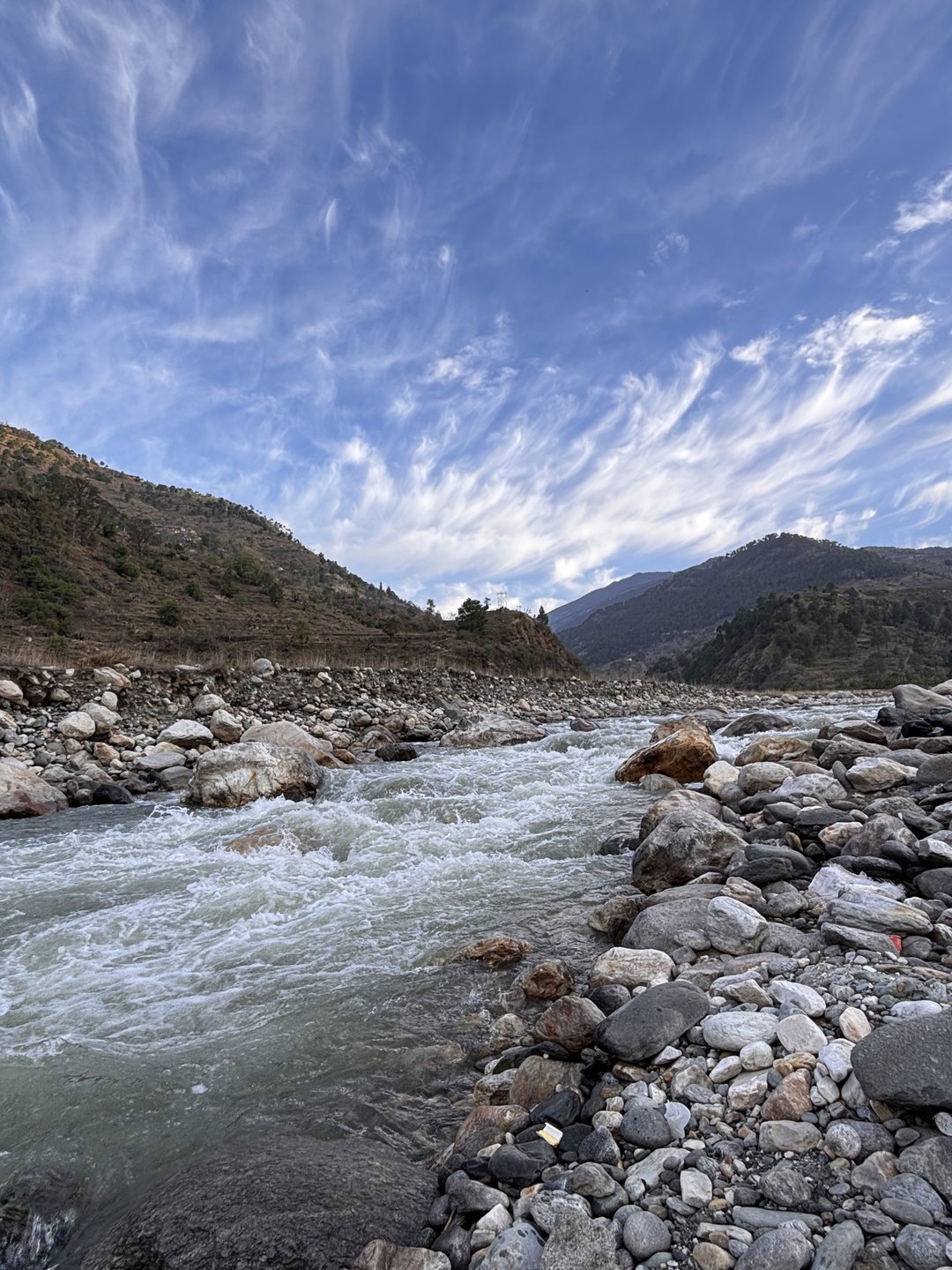
Water takes up oxygen from the air across its surface and from plants photosynthesising in it. Turbulence helps: a stretch running over rocks aerates far better than a still, deep, slow one. This is why the same river can be well oxygenated in the hills and starved of it on a flat urban reach.
Oxygen leaves the water when bacteria consume it to break down organic matter. The more sewage a stretch receives, the more oxygen is spent on decomposition and the less is left for anything else. That demand is what BOD measures, and DO and BOD are two ends of the same process.
Temperature matters too, and it works against the river in summer. Warm water physically holds less dissolved gas than cold water, at exactly the season when biological demand is highest and flow is lowest.
- mg/L
- Milligrams of oxygen per litre of water. Sometimes written ppm; for water the two are effectively interchangeable.
- Anoxic
- Effectively no dissolved oxygen. Aerobic life ends and decomposition switches to processes that produce hydrogen sulphide — the smell of the Delhi stretch in summer.
- Saturation
- The maximum a given water can hold at its temperature and pressure. A DO figure without a temperature is not a complete description.
What the law asks for
The bathing-water criterion, notified under the Environment (Protection) Rules, 1986 and printed in CPCB's own table header.
Dissolved oxygen, bathing water
> 5.0 mg/L
PWQC, Environment (Protection) Rules 1986
Reporting floor of the method
0.3 mg/L
CPCB, National Water Quality Monitoring Programme
Yamunotri, at source — minimum
11.2 mg/L
CPCB NWMP 2025, station 1492
Palla, entering Delhi — minimum
5.4 mg/L
CPCB NWMP 2025
Nizamuddin — minimum
0.3 mg/L
CPCB NWMP 2025
The last figure is the reporting floor. It is published as 0.3 because that is the lowest number the method returns, so the true value is at or below it. The honest reading is at or below — an instrument's limit is not a measurement of nothing.
How to read a DO figure
Three things have to travel with the number or it means very little.
When. DO swings across a single day — highest in the afternoon when plants have been photosynthesising, lowest before dawn when they have been respiring all night. A single reading without a time is a point on a curve nobody has shown you.
What temperature. Cold water holds more. A 6 mg/L reading in January and one in June describe very different degrees of saturation.
Minimum or maximum. CPCB publishes both per station per year. The minimum is the one that decides whether anything survives, because a river that goes anoxic for a month is not saved by a good reading in August.
What it does not measure
- It cannot identify what is consuming the oxygen. High demand from sewage and high demand from an algal die-off look identical in this number.
- It cannot be read as a health indicator for people. Oxygen tells you about the ecosystem; faecal coliform tells you about contact risk.
- A value at the reporting floor cannot be treated as zero, and cannot be averaged as though it were a measured number.
- It says nothing about metals, nutrients or anything that does not consume oxygen.
Where this comes from
Every figure above comes from one of these.
- Water quality data of river Yamuna, 2025 Central Pollution Control Board, National Water Quality Monitoring Programme · Every station figure above
- Primary Water Quality Criteria for bathing waters Central Pollution Control Board · The designated-best-use classification and its criteria
Reuse freely — CC BY 4.0. Each source above keeps its own terms.