
2–4 hours · Inside Delhi
CityScapes
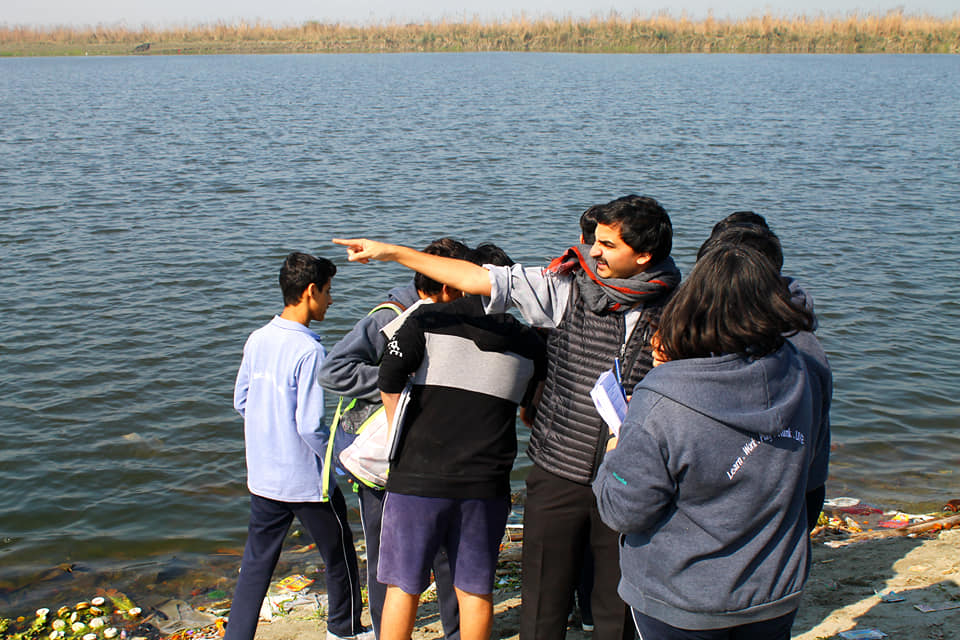
Two to four hours inside the city, at the six places it would rather you did not look at.
A morning. Whole classes, no travel beyond Delhi.
Read first: What is Delhi's AQI? · Why is Delhi's air so bad?
For schools
Six programmes, from a four-hour walk inside Delhi to twelve days down a thousand kilometres of river. All of them run for whole cohorts, all of them put a day of work in, and all of them are older than most of the people on them.
Ordered by how long they take.
2–4 hours · Inside Delhi
Two to four hours inside the city, at the six places it would rather you did not look at.
A morning. Whole classes, no travel beyond Delhi.
Read first: What is Delhi's AQI? · Why is Delhi's air so bad?
By arrangement
A learning lab on five acres. Day visits, short courses, internships and stays.
A day out, a short course, or a longer stay on five acres.
Read first: How to read environmental data
By arrangement
A module-based curriculum on land, water and air — five to sixteen sessions, plus exposure trips and action projects.
A term or a year inside the school itself, with teacher training.
Read first: What is PM2.5? · Why is the Yamuna so polluted in Delhi?
2–5 days · Several destinations
Two to five days in forest, mountain, desert or mangrove.
Two to five days in one of four ecosystems.
Read first: Forest cover or tree cover? · What is a heatwave?
4–5 days · Uttarakhand, Rajasthan, Gujarat, Himachal Pradesh
Four to five days in rural Uttarakhand, Rajasthan, Gujarat or Himachal.
Four to five days living in a village, not visiting one.
Read first: What counts as extreme rainfall?
12 days · Yamunotri to Agra · 1,000 km
Twelve days and a thousand kilometres, downstream, from the source to Agra.
Twelve days, source to Agra. For a school building a year around it.
Read first: Why is the Yamuna so polluted in Delhi? · What is BOD?
Not a syllabus. These are the things a cohort can do afterwards that it could not do before.
The difference between “the air was bad” and “PM2.5 was three times the 24-hour standard of 60”. One is an impression and the other can be argued with in a room full of adults.
Why a national figure is almost always modelled, why a street-level one is almost always measured, and why the two cannot be averaged.
Two government studies of Delhi's air put the transport share at 6–29 and 17–28 per cent. Holding that as the state of the knowledge, rather than picking the convenient end, is the skill.
Dissolved oxygen is what the river has; BOD is what is being taken out of it. Standing at Wazirabad and then at Okhla makes the two numbers physical.
India's own report says the forest grew; the satellites say it went. Both are right. Finding the definition that makes both true is the whole lesson.
Swechha has been doing this since 2000. The schools named on the programme pages are the ones that have gone on record with us — the Shriram Schools, Modern Schools, Vasant Valley School and Pathways World School among them.
The parts a coordinator has to plan around, stated plainly.
The cohort is the unit
These are designed for a whole class arriving together from one school, not for individuals. A week only lands if everybody goes back to the same corridor.
A teacher travels with the group
Somebody from the school is on every journey. What they carry back into a classroom is the part we never see.
The place sets the length
Two days in a forest and five in the Sunderbans are not the same trip and are not planned as one. A programme that runs to a single fixed length is selling logistics.
There is a day of work in it
Shramdaan is built into the journeys on purpose. Without it the whole thing is a viewing, and viewings do not change what anybody does afterwards.
Dates are set with the school
Season decides more than the calendar does: a desert day in May and a Sunderbans day in monsoon are different propositions. Tell us the window and we will say what fits it.
Costs are quoted per programme
They depend on destination, length and group size, so there is no single price to publish. Ask and you will get a figure for your cohort rather than a range you have to interpret.
Three things, and they are the school's
The cohort, a teacher who travels with it, and the window in the year it can go. Those three are yours; everything after them is settled together rather than handed over.
The route, the facilitation and the people on the other end
Where the group goes, who walks it through, who hosts it and what the day of work is. Gram Anubhav's village hosts and NatureScapes' four ecosystems are already in place — each programme page says who is at the other end of that one.
There is no calendar to click
Tell us the year group, roughly how many, what you have in mind and when in the year. That is enough to come back with something specific. The form below and the email beside it reach the same person.
One person reads these. Tell us the year group, roughly how many, what you have in mind and when in the year — that is enough to come back with something specific.
Eleven boxes, four of them required. Enough to come back with something specific rather than a brochure.
Prefer email? The link below opens a message to the same person.
Straight to a person
This goes to Vimlendu Jha, Swechha’s Executive Director.
Or write to vimlendu@swechha.in.
Read the knowledge library first
A school that has done two of the four ecosystems has something no single journey can give it.