
Teach · 6 of 8
Wasted!
Waste, and what happens to it
The background
What this theme sets out on waste, and what happens to it, before any session.
This theme was rewritten for India by Swechha in September 2026. The manual was written elsewhere and taught elsewhere: its waste figures were foreign or unsourced and have been removed rather than converted, and its examples have been replaced with Indian ones — the kabadiwala, the dhalao, paddy straw, malba, the sachet nobody will buy, the landfill on the edge of town. The only India figures used are the Central Pollution Control Board's, from its Annual Report on Solid Waste Management 2021-22. Two foreign passages were re-attributed rather than cut, and both still say whose they are: the United States Environmental Protection Agency's Sustainable Materials Management programme, which is where the term “secondary waste” comes from and which governs nothing in India, and a magazine's estimate of American Cold War nuclear contamination, which is an estimate and not an official figure. The waste categories and the structure of the chapter are the manual's own.
1. BACKGROUND, CONTEXT & KNOWLEDGE:
Waste is whatever we decide we no longer want. That is the whole definition, and it is worth sitting with, because it describes a decision, not a material. A steel glass and a paper cup both hold chai. One gets washed. The other gets thrown.
The waste we can actually see — on the street, in the nali, heaped at the dhalao — is what most people simply call kachra. It comes from homes, from schools and shops and offices, and from factories. India produces 1,70,339 tonnes of solid waste on an ordinary day and collects 1,56,449 tonnes of it, a collection rate of 92% (Central Pollution Control Board, Annual Report on Solid Waste Management 2021-22). That is higher than almost anybody guesses. The trouble starts after collection.
The manual sorts waste into four families: industrial, commercial, domestic and agricultural. India needs three more names on the board: biomedical waste from hospitals and clinics, e-waste from the phone in your pocket, and building rubble — malba — which every Indian city produces and very few manage.
2. KEY THEMES & QUESTIONS:
2.1 TYPES OF WASTE I
2.1.1 Biodegradable waste — waste that microorganisms can break down into simpler, harmless substances. Peels, leftovers, tea leaves, garden cuttings, paper, cattle dung. In an Indian kitchen this is the heavier and wetter half of the bin, and it is the half that can be handled for almost nothing: a pit, a drum, a handful of earthworms, a gobar gas plant. Mixed in with everything else, the same material turns into leachate and methane at the bottom of a dump.
2.1.2 Non-biodegradable waste — waste that microorganisms cannot break down. Plastic, metal, glass, rubber, paint, chemicals. It does not disappear; it only gets smaller. Buried, it sits. Burnt, it goes into the air and comes back down. Some of it is worth real money, which is why the kabadiwala will weigh your newspapers and your old bucket and pay you for them. The dangerous part of this stream is the part nobody will pay for.
TYPES OF WASTE II
2.2.1 Industrial Waste
Industrial waste is everything a factory produces apart from its product. Metal offcuts, sludge, solvents, ash, canteen food, packing material, and the effluent that leaves through a pipe. In India a great deal of it leaves through that pipe into a river — which is why the Yamuna below Delhi and the Ganga at Kanpur's tanneries look the way they do.
Types of industrial waste
Industrial waste is either hazardous or non-hazardous, and both do damage when they are handled badly. The bulkiest kind is industrial solid waste.
Solid waste comes out of processes such as:
- Electricity generation — coal-fired power stations leave behind mountains of fly ash
- Agricultural and inorganic chemicals, and iron and steel making
- Water and sewage treatment, which leaves sludge
- Plastics and resin manufacturing
- Most other kinds of manufacturing, in smaller quantities
Toxic waste. Some industrial waste is poisonous — to people, to animals, to whatever is downstream. It is usually a by-product of something else made at a factory, a hospital or a workshop. What counts as hazardous, who has to take it back and where it may go are all set by law, and that law is enforced by the state pollution control board rather than by the municipality.
Chemical waste. Waste full of chemicals is not automatically hazardous in the legal sense. It qualifies if it catches fire easily, eats through what it touches, reacts violently, or is toxic.
Secondary waste. The United States Environmental Protection Agency's Sustainable Materials Management programme — named here because that is where the term comes from, not because it governs anything in India — pushes industry to reuse the non-hazardous leftovers of production instead of dumping them.
Secondary waste includes ash from burnt coal, used foundry sand, and the rubble left when a building comes down.
Commercial Waste
Commercial waste comes from places that run a trade or a business, or that exist for sport, education or entertainment. Shops, markets, offices, hotels, cinemas — and schools. A school's own bin is commercial waste, which is a useful thing to say out loud in a classroom.
In an Indian city this stream is mostly packaging — cartons, crates, wrappers, thermocol, the plastic film around everything — plus a great deal of food waste from restaurants and banquet halls. Building rubble gets lumped in with it, although malba has its own rules and its own fleet of trucks.
It is sometimes called business waste. Getting rid of it is the business's own job, not the municipality's. A company is expected to arrange its own collection, treatment and disposal.
Small shops and market associations usually fall under municipal collection instead, and what they throw is counted as municipal waste. A business large enough to be on its own hires a waste handler — and the honest test of that arrangement is not the invoice but whether anybody can say where the waste actually went.
Domestic Waste
Domestic waste is what a household throws out while cooking, cleaning, repairing, unpacking and shopping. Peels and leftovers, tea leaves, packaging, broken things, old clothes, and polythene — a great deal of polythene.
Most Indian homes already sort their waste; nobody calls it segregation. Newspapers are stacked for the kabadiwala. Glass bottles and old steel go the same way. Leftovers go to the cow at the gate or the dog on the street. India had a recycling economy long before it had the word. What is left after all that — the mixed, wet, wrapped remainder — is what goes into the bin, and that remainder is what the system chokes on.
The Solid Waste Management Rules, 2016 ask every household to hand over waste in three separated streams: wet, dry, and domestic hazardous — batteries, tubelights, expired medicine, paint tins. How far this happens depends entirely on the street. Where door-to-door collection works, it works. Where it does not, waste ends up at the roadside, at the dhalao, or in the nearest drain. It also gets mixed with biomedical waste from small clinics, which is illegal and common.
The people who handle all of this pay for it with their health. Municipal sanitation workers and waste-pickers — the manual calls them rag pickers — sort through mixed waste, often with bare hands and no mask or boots, and get eye infections, breathing problems, stomach illness and skin disease for it. They are also the reason recycling happens in India at all. The sorting that an expensive machine does elsewhere is done here by hand, by people the city does not employ and does not count.
Animals eat it. Cows, buffaloes, stray dogs and birds go through roadside waste looking for food and swallow the plastic that the food was wrapped in. Cattle in Indian cities are routinely found with bags packed into their stomachs; they stop digesting properly, and they die of it. Milk from an animal grazing on a rubbish heap is not the same milk. Uncollected waste also washes into drains and rivers and changes what is in the water, while what leaches out of a dump soaks down to the groundwater and poisons the soil around it.
And it blocks drains. A drain packed with polythene holds standing water, standing water breeds mosquitoes, and mosquitoes bring dengue, chikungunya and malaria. The monsoon flooding that shuts an Indian city for a day is often a waste problem wearing a weather costume.
Agricultural waste
Agricultural waste is whatever farming produces that nobody can sell or use — the leftovers of growing crops and keeping animals. Straw, husk, stalks, prunings, dung, empty pesticide bottles.
Farming feeds the country, and farming leaves a great deal behind. Almost every agricultural activity generates waste, and in India the volumes are enormous because the sector is enormous. Handled badly, it damages health and costs money. Handled well, most of it is not waste at all.
Most of it can go back into the soil or into a fuel. Crop residue can be composted, ploughed back in, or digested into gas. Dung makes manure, and it makes cooking gas. Rice husk and sugarcane bagasse are burnt for power in the very mills that produce them. Each of these turns a disposal problem into something with a price on it, and creates work while doing so.
Empty pesticide, insecticide and herbicide containers are the sharp edge of this. They are handled by people who were never trained to handle them and are rarely told what is inside. A little product always stays in the bottle. A bottle rinsed into a pond or dropped in a field is a poisoning waiting to happen, and it usually poisons somebody who never used the chemical.
The largest agricultural waste problem in India is what happens to paddy straw. After the paddy harvest in Punjab and Haryana the fields have to be cleared fast for the wheat sowing, and the cheapest way to clear them is to set them alight. The smoke does not stay in Punjab. This is where the waste chapter and the air chapter meet, and a class that has done both should be asked to join them up.
Agricultural solid waste sorts roughly as follows:
- Animal production waste — bedding and litter, carcasses, broken feeders and water troughs, and above all dung.
- Crop production waste — what is left in the field after harvest: straw, stalks, husk, leaves.
- Food and meat processing waste — from mills, dairies and slaughterhouses: hooves, bones, feathers, peels, pulp, whey.
- On-farm medical waste — vaccine vials and wrappers, used needles and syringes from treating animals.
- Horticultural waste — prunings, grass cuttings and trimmings, including everything a municipal park sweeps up.
- Industrial agricultural waste — sawdust and offcuts from wood, and the residue of making paper, board and fibre out of crops.
- Chemical waste — empty pesticide, insecticide and herbicide containers, thrown into ponds and open fields with a little of the chemical still inside, from where it reaches food and water.
3. What agriculture's waste does to health and climate:
Burning crop residue in the open puts smoke, soot and gases straight into the air that people are breathing, and warms the planet at the same time. Livestock produce methane and nitrous oxide, both of which trap far more heat than carbon dioxide does. It runs in both directions: mishandled farm waste changes the climate, and a changed climate makes food harder to grow.
Some of what follows from that:
3.1 Floods — waterways get blocked, either because people build on them or because they fill with dumped waste. Blocked water has to go somewhere, and where it goes it takes lives and land with it.
3.2 Pollution from burning and dumping — waste burnt in the open pollutes the air; waste dumped in the open pollutes the ground and the water under it. Both are avoidable, because this particular waste is rich in exactly the nutrients a field wants back.
3.3 Food security — more people means more farming, which means more agricultural waste, and the food itself is part of it. Food that is grown, harvested, moved and then never eaten is the largest waste stream nobody sees. In India it is lost in transit, in storage and in the mandi long before it reaches a plate. The global goals include ending hunger; any serious attempt at that starts with the food we already grow and lose.
4. Waste management
Of everything India handles, 54% is treated or processed and 24% is buried in a landfill. The other 22% — 37,373 tonnes every single day — has no recorded destination at all (Central Pollution Control Board, Annual Report on Solid Waste Management 2021-22). That gap is what this section is about. Waste management is rarely a technology problem: the technology exists and has existed for decades. The problem is that people expect to throw things away without thinking, expect somebody to remove them promptly, and then object when the removal ends up anywhere near them. Every proposed landfill and every waste-to-energy plant meets a residents' association. In a perfect world there would be no waste at all, only raw material. In the real one, some materials recycle well and many do not, and recycling anything at all requires it to be separated — which is cheapest and easiest at the moment it is thrown, in the house. Once it is mixed, the cheapest option is a lorry to the nearest dump, which is also the worst option. Separating mixed waste afterwards is dirty, dangerous work, and even then you are left with streams that still have to be composted, burnt or buried.
Management of industrial solid waste
Managing industrial solid waste is not the municipality's job. The industry that makes it has to deal with it, and has to get authorisation from the state pollution control board to do so. The methods vary; the steps are the same everywhere.
- Segregate. Separate the waste into biodegradable, non-biodegradable and hazardous before anything else happens to it. Everything downstream depends on this one step.
- Collect and transport. Move it to a facility built to take it.
- Recover. Pull out whatever still has value — metal, solvent, heat, fibre.
- Recycle and dispose. Send the recovered material back into use, dispose of the rest safely, and keep a record of where it went.
Non Biodegradable Waste Management
- Recycling
Recycling is the workhorse. Plastic, paper, glass, metal and cloth can all go round again, and in India they usually do — not through a municipal scheme but through the kabadiwala, the scrap dealer and the waste-picker, who between them have priced recyclable material by the kilo for as long as anyone can remember. It keeps material out of dumps and saves the energy of making it from scratch. Its limit is its logic: this economy only moves what somebody will pay for. A shampoo sachet or a chips packet is made of layers that cannot be separated, so nobody buys it, so it stays on the ground.
- Incineration
Incineration is burning waste in a controlled furnace, usually waste that cannot be recycled. It shrinks the pile dramatically. It does not make the pile harmless: whatever was in the waste either leaves as gas through the chimney or stays behind as ash, and burning mixed waste that includes plastic releases some very unpleasant things. An incinerator changes waste's form and its address. It does not make waste vanish.
- Individual Management
Individual management is where all of it starts. Two bins at home, wet and dry, and a third box for batteries, tubelights and old medicine. Hand the dry stream to the kabadiwala or the collector. Keep the wet stream out of plastic bags. Nothing further down the chain works if this does not happen, and everything further down the chain gets cheaper if it does.
5. Zero Waste Initiatives
Zero waste begins with knowing what you actually throw. A school, an office or a housing society that weighs its own bins for one week usually finds the answer obvious and embarrassing: most of it is wet waste that could have been composted on site, and most of the rest is packaging that could have been refused at the gate.
What follows is a set of things people are trying. Some are Indian, some are not, and some will not work. Read them as arguments, not as answers.
Plastic Roads
Plastic in the ocean, plastic in the forest, plastic in the road. The last one is real, and India got there first. In Madurai, Professor Rajagopalan Vasudevan worked out that shredded plastic waste could be melted onto hot stone chips and mixed into bitumen, and roads have been laid that way across the country since. It uses the plastic nobody will buy — bags, wrappers, film — and the roads stand up well to heat and rain.
That is a use, not a cure. A road made of plastic is still plastic, and roads wear. Elsewhere the same idea is being tried differently, as hollow prefabricated blocks laid end to end like a line of biscuits. Put the question to the class in its sharpest form: is a road the right place to store the plastic nobody would buy? (Video, 2:31 — https://www.youtube.com/watch?v=QBZN2UAfvwY Plastic Road – A revolution in Building our Roads)
Fly Larvae to Recycle (Organic) Trash
Eating insects turns most stomachs. Feeding insects on our leftovers should not. Food that is grown and then thrown is one of the largest and least visible waste streams there is, and in a dump it does not simply sit — it rots without air and gives off methane.
Organic waste in a dump is a climate problem and not only a smell problem. It is also fuel and feed that somebody threw away. Meanwhile land is cleared to grow crops to feed animals, which is a slow and lossy way of producing food for people.
Black soldier fly larvae cut straight through that. They eat food waste at astonishing speed, fatten on it, and become protein. In China, restaurant food waste is already fed to them, and the fattened larvae go to chickens and fish. India runs the low-technology version of the same logic at every scale: leftovers go to the cow at the gate, to the street dog, to the hens behind the house, and a housing society's wet waste goes into a composting drum instead of a truck.
What all of these have in common is that the organic waste never becomes waste at all. It stays inside a loop — food, leftovers, animal, soil, food. The only thing that breaks the loop is mixing it with plastic.
Composting Human Bodies
Death has a footprint too, and different traditions carry different ones. India mostly cremates, and a traditional pyre uses a great deal of wood; electric and CNG crematoria use far less and are now common in Indian cities. Burial uses land. Every one of these practices is somebody's faith before it is anybody's environmental question, and a classroom should treat it in that order.
In parts of the West an alternative is now offered: composting a body into soil rather than cremating or burying it. The argument behind it is specific to Western burial practice, where bodies are embalmed, take a long time to break down, and are placed inside manufactured caskets, headstones and grave liners — embalming fluid reaches groundwater, and all that manufacturing has a cost of its own. The Indian version of this question is a different one, and it is mostly about wood.
Building With Glass
Glass recycles well and endlessly, and India has been doing it the simple way for a long time: the thick returnable bottle that goes back to the shop, gets washed, and gets filled again. Every bottle that goes back is a bottle nobody had to melt. Glass that does not go back does not rot either. It only breaks into smaller and sharper pieces.
So what happens to broken glass that nobody will re-melt? Some engineers have a blunt answer: build with it.
Waste glass can be turned into building material without re-melting it, and without much water.
That matters because conventional glass recycling is fussy. As of 2018 it needed glass sorted by type and then melted again, which takes a lot of energy.
Mixed broken glass can instead be made into a “polymeric glass” that behaves and looks like stone — kitchen and bathroom counters, floors, wall tiles. Cutting stone out of a hillside, when the same thing can be made from a crate of broken bottles, is a strange choice.
Packaging is the other half of this argument. A handful of shops abroad now stock nothing that cannot be composted, recycled or reused, down to the packaging the goods arrive in.
In practice, going completely package-free is hard. Some products — menstrual cups and other sanitary goods among them — are legally required to be packaged.
But required packaging does not have to be non-recyclable plastic. That distinction is the whole point of a zero-waste shop.
At some shops abroad, customers bring their own containers and bags, weigh them empty at the door, fill them, and pay at the counter.
No bags, no boxes, no film. India has a version of this older than the idea itself: the kirana shop that pours dal, rice, sugar and oil into whatever you brought, and the milkman who measured from his can into your own vessel. It never needed a name.
It saves the shop money and it saves the customer a bin full of packaging. The sachet and the sealed packet replaced it because they were cheap, portable and hard to adulterate. The bill for that convenience arrives later, as waste that nobody will buy.
5.5 Turning Waste to Energy
Burning waste to make electricity is now a large global business, and India has plants doing it. Whether it works depends almost entirely on what goes into the furnace.
Sweden was among the first countries to build this at scale, and got good enough at it to run short of its own rubbish — so it began importing other countries' waste to keep the plants running.
Almost none of Sweden's household waste now goes to landfill; a great deal of it heats Swedish homes instead. The Indian catch is segregation. A furnace fed on wet Indian waste mixed with plastic burns badly, makes less power than promised and more pollution than permitted. Waste-to-energy is only ever as good as the bin it starts in.
Poo Power
Sewage is the other great organic waste stream, and it is at least as large as the commercial one. It is also energy, sitting in a drain.
Researchers in the United Kingdom have built a toilet that needs neither water nor electricity — two things a very large number of people do not have. It is being trialled in Ghana.
It separates water from solid human waste. The water can be used for irrigation, for washing, even for drinking.
The gas is turned into energy, and what solids remain can be burnt as fuel or used as fertiliser. (Video, 3:40 — https://www.youtube.com/watch?v=iX0jAn-iNng Cranfield Nano Membrane Toilet)
India's own version of this is older and far more widespread: the gobar gas plant. Dung and water go into a sealed pit, bacteria work on it without air, methane comes out of a pipe and burns on a kitchen stove, and what is left over is good manure. The twin-pit toilet works on the same principle — one pit fills while the other rests, and what comes out of the rested pit is soil. The first session of this chapter builds a small version of it in the classroom.
Recycling Cigarettes
Cigarette butts are the litter nobody counts as litter. In the United States they are the single most littered item; in India you can establish the same thing without any survey at all by standing outside a paan shop and looking down.
The filter is not cotton and it does not rot. It is plastic, and it holds everything the smoker did not inhale — tar, nicotine, arsenic, heavy metals. Rain takes all of that into the drain.
India's version of the pile has extra items in it: beedi ends, and the gutkha and pan masala pouches that carpet the ground outside the same shop. Each one is small, unsellable and so light that nobody bothers to sweep it.
Cleaning them up matters, and cleaning them up is nobody's job. That is the only reason schemes that pay for them exist.
Companies such as TerraCycle pay volunteers to collect cigarette ends and post them in, strip out the ash and waste, and turn the filters into plastic pellets. It is a workaround, not a fix. The fix is a filter that rots, or a smoker who uses a bin.
Roofs Made From Recycled Paper and Plastic
A flat commercial roof gets replaced several times over a building's life, so what the roof is made of adds up. One company makes roof cover board out of waste paper and plastic, then takes the board back at the end of its life to make the next one — a closed loop, on a roof. (Video, 1:08 — https://www.youtube.com/watch?v=WXYK6QpEihY EVERBOARD roof cover board by Continuous Materials)
India has its own version of this, and it is already on roofs across the country. Used tetra pak cartons — the ones milk and juice come in, made of paper, plastic and aluminium bonded together and therefore hopeless to pull apart — are pressed into corrugated roofing sheets and boards. The material that defeated the kabadiwala turns out to make a decent roof.
Never Waiting for Ketchup
Anything thick that comes in a bottle leaves some of itself behind on the walls. Ketchup, shampoo, oil, the last of the achaar. You shake, you tap, you give up, you throw it.
Multiply that by every bottle in every kitchen. It is food thrown away, and it is packaging that cannot be recycled because there is still food stuck in it — a dirty container is worth nothing to a kabadiwala, which is exactly why rinsing a bottle before you hand it over is not fussiness.
What is needed is a container that empties completely.
LiquiGlide is a coating that makes the inside of a bottle so slippery that the contents slide out. Less food wasted, less money wasted, and a container clean enough to actually be recycled. Indian kitchens have been solving this by hand for generations — the splash of water swirled around the jar and tipped into the dal. The technology is new. The instinct is not.
Electronics Recycling
That dead phone in the drawer looks harmless. It contains lead, mercury, cadmium and beryllium, and it is worth money — which is why India's e-waste does not sit in drawers for long. Much of it reaches Seelampur in Delhi, the country's largest dismantling market, where it is taken apart by hand, often by very young workers, and circuit boards are soaked in acid to get the metals out. What is left is packed off to places like Loni and Moradabad for the smelting and burning, which is how the dirtiest step ends up somewhere other than where the dismantling happens.
That recovers the gold and the copper. It also puts the lead, the mercury and the fumes into the people doing it and into the ground they are standing on. India's e-waste rules make producers responsible for taking their own products back through authorised recyclers. Most e-waste still goes the other way, because the informal trade pays more and comes to your door.
There is a second reason people hold on to old devices: what is on them. A phone or a laptop handed to a stranger is a phone or a laptop handed to a stranger. An authorised recycler is supposed to wipe, dismantle and shred before anything moves further down the chain — and “authorised” is a thing you are allowed to ask to see.
Pulling Carbon Out of Thin Air
We are putting far too much carbon into the air. Several companies are now trying to take some of it back, and the most interesting attempts treat carbon as a waste with a use. A Montreal company called Carbicrete makes concrete without cement.
Cement is the part of concrete that releases carbon dioxide while it is being made, so leaving it out already avoids emissions. Carbicrete then injects carbon dioxide into the product itself, so the block holds carbon instead of releasing it.
The method: take steel slag — a waste product of steel plants — and cure it with purified carbon dioxide in a sealed chamber. What comes out behaves like ordinary concrete.
It can be used for roads, driveways and buildings. India already does something related, and at enormous scale: fly ash, the waste of coal-fired power stations, is pressed into bricks and blended into cement. A waste that used to sit in ash ponds now holds up walls.
Carbon dioxide can also be remade into ethanol, ethylene and methanol — the building blocks of the fuels it came from. The idea underneath all of this is the idea underneath composting: nothing is waste if something downstream wants it.
Technology to Clean up Our Oceans
The largest rubbish dump on earth is not on land. It floats in the Pacific between Hawaii and California and is called the Great Pacific Garbage Patch. It is not a solid island. It is a vast, thin soup of plastic that the ocean currents have gathered into one place.
https://www.youtube.com/watch?v=0EyaTqezSzs The Great Pacific Garbage Patch Explained (Video 2:40)
It is not the only one; currents build patches like it in several oceans. Left alone, sun, wind and waves grind the plastic into microplastic, which is effectively impossible to get back out. Plastic does not biodegrade. It only becomes smaller plastic, and then it is inside a fish, and then it is on a plate. So the work runs in two directions at once: stop plastic going in, and take out what is already there while the pieces are still large enough to catch.
The Ocean Cleanup is the best-known attempt at the second half of that.
Here's how it works: https://www.youtube.com/watch?v=O1EAeNdTFHU The Ocean Clean Up System Explained (Video 2:32)
A long floating barrier rides the surface, pushed along by currents, wind and waves. A deep skirt hangs below it, so plastic cannot slip underneath and debris cannot wash over the top.
A vessel comes and empties it, like a garbage truck. What it collects goes back to land to be recycled.
How much of the ocean's plastic this can actually remove is argued over, and the project's own projections are the most optimistic ones in the argument. The simpler point holds: almost all ocean plastic arrives by river. India's answer is therefore upstream — what does not go into the Yamuna cannot come out of the Arabian Sea. At Versova in Mumbai, volunteers went back week after week for years to clear the beach, and in 2018 olive ridley hatchlings were seen there again after about twenty years. Whether the clearing is what brought them is not settled, and a class is better off arguing that than being told.
5.13 Smart Meters: Reduce Household Electricity Consumption
Research in Europe found that households with smart meters use less electricity than households without them.
A smart meter shows people where their electricity is actually going, so an unexplained load becomes visible instead of arriving as a shock at the end of the month. India is now installing prepaid smart meters widely.
The saving per house is modest. What makes it interesting is that it comes from information alone — nobody buys a new appliance, they simply find out what the old one costs to run. Waste you cannot see is waste you cannot cut.
5.14 Use Fungus for Nuclear Waste Clean-Up
The United States produced a very large quantity of radioactive waste during the Cold War, and it is worth a class knowing that the country which regulates this most loudly has an unresolved legacy of its own. Much of it was never properly disposed of and has been leaking out of underground storage tanks since the 1950s. Popular Science has put the contamination at nearly 800 billion gallons of water and over 2 billion cubic feet of soil — that is a magazine's estimate rather than an official figure, and a class should be told the difference.
Cleaning up nuclear waste harms the people who do it. Some strains of yeast, however, live quite happily in conditions that are both intensely radioactive and strongly acidic.
These fungi cannot make the radioactivity go away — nothing can. What they might do is turn the seeping, acidic sludge into something less harmful, or grow a biofilm that acts as a seal over it.
Whether that works at any scale is not yet known. It is a real line of attack on a waste once thought to be permanent, and permanent is the word that matters here: this is the one waste stream that outlasts every institution built to look after it.
5.15 Zero Waste and Package-Free Stores
Zero-waste shops are real and spreading. The principle is exactly what it sounds like: nothing in the chain, from making the product to carrying it home, needs to be thrown away. In India this is not a new model so much as a returning one — bring your own container, buy by weight, take home the thing and not the wrapper.
___________________
The sessions
5 sessions for this theme. Take one, take all of them, or change them for your own room.
-
01
Dung PowerSession 1 of this theme.
-
02
What is waste? /Understanding WasteThis session builds an understanding of waste: what it is, where it comes from, and what goes wrong when it is…
-
03
My WasteTo look honestly at our own waste-producing habits.
-
04
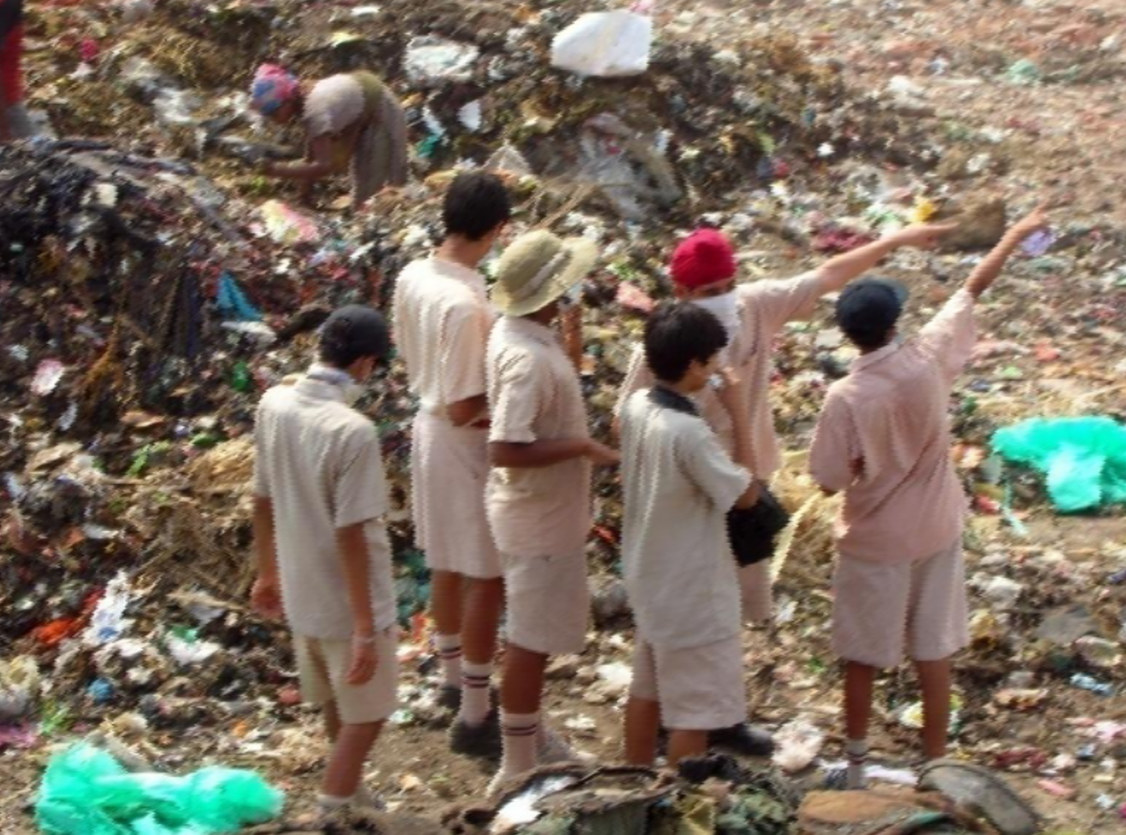
Exposure WalksChoose one: a landfill walk, or a visit to a recycling unit. Which one depends on the age of the students and the…
-
05
Reflecting Back on LearningsTo pull together what the class has seen and learnt so far, and to find out what they actually make of the waste…
Next
The other themes, and what to read first.
Start here
Before you startHow to teach this, and why it is taught this wayAll eight
Teach43 sessions across 8 themesLook a word up
The A to Z334 environmental terms, defined plainlyThe other themes
- Sustainable DevelopmentSustainable development · 11 sessions
- Blowing in the WindAir pollution and what it does to a body · 3 sessions
- Water, Water, EverywhereWater, and not a drop to drink · 8 sessions
- Food on my PlateWhere food comes from · 3 sessions
- Future and EnergyEnergy and the future · 5 sessions
- Trees and ForestsTrees, forests and how they grow · 4 sessions
- Climate Justice and Active CitizenshipClimate justice and active citizenship · 4 sessions