
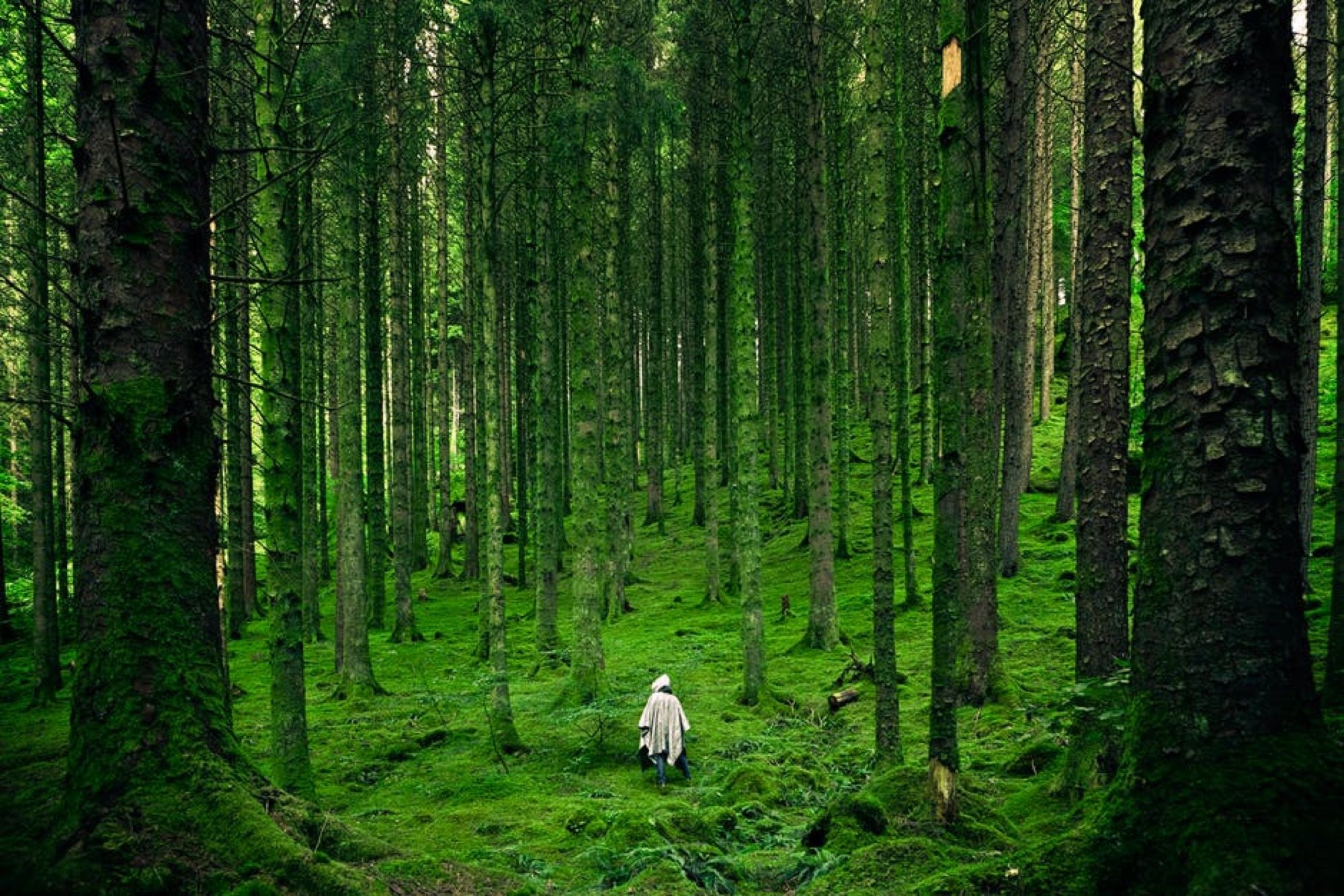
India’s forest loss
Every reading against its published limit. Every gap named.
Year round
PERIODIC — annual satellite series, biennial official report
2.43M ha
tree cover lost, 2001–2025 · 24,257 km²
3.4% of India’s recorded forest cover
The Forest (Conservation) Act, 1980 caps who may decide, not how much. There is no permitted quantity.
Hansen / UMD, at 30% canopy density. What each one measures.
And India’s own report says it went up
Over its last two assessments the Forest Survey of India recorded a net national increase of 156.4 km².
Both figures are official. Neither is wrong. They measure different things — and the difference between them is the most useful thing on this page.
One number survives either definition. That national net gain of 156.4 km² is 2.4 times smaller than the loss in Madhya Pradesh alone, which the same report puts at 371.5 km². Both figures are in one table.
Two sources
Three, in fact — and two of them are not independent, which matters more than the disagreement.
A · India’s own assessment
+156.4km²
Forest Survey of India, Ministry of Environment, Forest and Climate Change, India State of Forest Report 2023, Volume 1. Satellite imagery classified by canopy density, every two years. This is the number the Government of India reports to FAO.
B · the international series
+88,000km²
FAO, via the World Bank. Forest area 6,39,380 km² in 1990 to 7,27,390 km² in 2025. Not an independent check: FAO republishes what each country reports, and for India that is source A.
C · the satellite measurement
−24,257km²
Hansen / University of Maryland, published by Global Forest Watch. Canopy change measured from Landsat, every year. This is the one that disagrees, and it is the only one not derived from what the government reports about itself.
Counted or measuredModelled
Two sources agreeing is not corroboration when one is the other’s input. A and B move together because B is built from A. So the honest reading of this page is not “two against one” — it is one administrative measurement and one independent one, and they point in opposite directions.
What each one measures
A plantation is forest cover. A harvested plantation is tree cover loss. Both statements are true, and that is the entire disagreement.
India’s definition
All land more than one hectare with tree canopy density above 10 per cent, irrespective of ownership, legal status or species. A plantation counts. An orchard can count. This is why 'forest cover' and 'forest' are not the same word.
The definition is the reason two honest sources disagree about whether India is gaining or losing forest. It measures canopy, not ecosystem.
Of India’s 32,87,469 km², 21.8% is forest cover and 3.4% is tree cover outside it. Table 2.3 — Forest and Tree Cover of India.
The satellite’s definition
Canopy disappearing, whatever it was and for whatever reason — felling, fire, storm, disease, harvest. It does not say why, and it is not net change: gain is a separate measurement on a different method and the two are not subtracted here.
Loss is counted above 30% canopy density in 2000. GFW's own headline figures use 30 per cent. It is a CHOICE and a different choice gives a different answer, so it is printed wherever the number is.
These are nested, not separate. cumulative nested subsets — the 10% figure INCLUDES the 30% figure Summing across thresholds double-counts and gives roughly eight times the real total.
Same ground, two answers
A natural forest replaced by a plantation of the same canopy density is no change to forest cover and a loss and a gain to the satellite. Neither number is wrong.
So is the satellite series just counting plantation harvests? No. 93.7% of the measured loss was outside any planted forest — 22,72,357 hectares of 24,25,649. That objection is the commonest one made about this dataset, and on the dataset’s own fields it does not hold.
And 15.3% of it was primary forest — 0.37 million hectares of loss inside forest mapped as regional primary forest in 2001 — mature natural forest, the part that does not come back on a human timescale.
Sources.
India State of Forest Report 2023, Volume 1 ·
Hansen / UMD via Global Nature Watch,
dataset gadm__tcl__iso_change/v20260407.
Twenty-five years
2.43 million hectares, one year at a time. It has roughly doubled.
all tree cover loss the part that was primary forest
2001–2013 lost an average of 65,162 hectares a year. 2014–2025 lost 1,31,545 — 2 times as much. The worst single year is 2017, at 1,79,260 hectares; the lowest is 2003, at 43,831.
Tree cover loss is not deforestation. It counts canopy disappearing for any reason — felling, fire, storm, disease, harvest — and it does not say why. It is not net change. Gain is a separate measurement on a different method and the two are not subtracted from each other here.
Every year, 2001 to 2025
Hectares, at 30% canopy density.
Where it went
A net figure hides its own components. This is what the +156 km² is made of.
The five biggest state losses and the five biggest gains between India’s last two forest assessments. The tick marks the national net figure, 156.4 km² — so every bar reaching past it is a single state moving more than the whole country appeared to.
A net figure hides its own components. The national net gain is 156.41 km2. Madhya Pradesh alone lost 371.54 km2 — more than twice the entire national net gain — and Mizoram alone gained 241.73 km2, more than the whole national net. Both statements are arithmetic on the report's own published numbers and neither is an interpretation.
And the scale of it. 156.41 km2 on a base of 715,342.61 km2 is a change of about two hundredths of one per cent. It is well inside what a mapping method can produce by changing nothing on the ground.
ISFR publishes no national gross gain or gross loss — only a net, plus per-state changes. So the total area of forest India actually lost over those two years cannot be computed from the report at all.
And "forest cover" includes plantations and orchards. There is no natural-forest-only series in the report, so the question most readers are asking cannot be answered from this document alone.
What the law says
There is no legal maximum. There is a legal gatekeeper — and that is a different kind of limit from every other one on this site.
The Forest (Conservation) Act, 1980
Forest land may not be used for a non-forest purpose without prior approval of the central government. Approval is normally conditional on compensatory afforestation and payment of the net present value of the land.
The Act does not cap how much forest may be diverted. It caps who may decide. There is no exceedance to report — only how much was approved, and that figure is published by the Ministry rather than by FSI.
Every other situation on this site reads a number against a threshold somebody notified. Air has an AQI limit. The Yamuna has a dissolved-oxygen minimum. Heat has IMD’s criteria. Forest has an approval process. What is on the record is how much was approved, by whom, and whether the forest came back.
Diversion approvals under the Act are not in ISFR. FSI measures the cover; the Ministry keeps the approvals, and the two are not published together.
And who is looking
Views of the English Wikipedia article on deforestation in India. Peak 1,715, floor 305 — a swing of 5.6×. It is the thinnest attention series of any situation on this site. A national net gain of 156.4 km² generates less interest than a single felling with a photograph, and that is the honest shape of it.
50 items from 30 publishers. Reporting is tagged as reporting.
Read the 40 most recent items
- India approved diversion of 215,943 hectares of forestland in 12 yearsDown To Earth · 05 Aug 2026
- Raigad collector strikes down 30-acre private forest land diversion in Navi MumbaiThe Times of India · 01 Jun 2026
- How India’s ‘greenest state’ is sacrificing massive forest land to miningThe Federal · 25 May 2026
- 150-acre private forest destroyed near Karnala Fort & Sanctuary areaThe Times of India · 03 Jun 2026
- SOE 2026: Forestland diversionDown To Earth · 25 Feb 2026
- Forest Destruction: The Hidden Cost of India's Industrial AmbitionsThe Probe · 27 Jun 2024
- India’s forests are disappearing, but not on paperDialogue Earth · 17 Apr 2025
- Forest Conservation Act 1980, Objectives, Provisions, FrameworkVajiram & Ravi · 11 Nov 2025
- 3 lakh hectares of forest land diverted for non-forest use over 15 years, compensatory afforestation programme a showpieceSabrangIndia · 11 Sep 2023
- Harnessing the Power of India’s Forests for Climate Change Mitigationorfonline.org · 12 May 2023
- What India risks as its natural forests disappearCarbon Copy · 24 Nov 2025
- Meet the young Samaritans saving India's forestsFairPlanet · 28 Nov 2022
- Data: Over 3 Lakh Hectares of Forest Land Diverted for Non-Forest Use in the Last 15 YearsFACTLY · 21 Aug 2023
- Human-animal conflict rises in India as forest land diversion hits decade highMedia India Group · 31 Jul 2025
- Report on Forest DiversionINSIGHTS IAS · 25 Mar 2025
- [Analysis] Developers should pay a higher Net Present Value for cutting forestsMongabay India · 26 Apr 2022
- Former bureaucrats raise concerns over rapid deforestation due to development projectsThePrint · 17 Sep 2026
- Deforestation charges derail House as Congress presses Hasdeo issueThe Times of India · 16 Dec 2025
- SC orders Centre, states to refrain from steps that lead to ‘reduction of forests’Down To Earth · 05 Feb 2025
- India’s new forest rules spark dismay — and hope: Q&A with activist Soumitra Ghoshnews - Mongabay · 17 Jan 2024
- Uttarakhand lost over 50,000 hectares of forest land since 1991: MoEF dataSabrangIndia · 28 Jul 2023
- The Forest Conservation (Amendment) Act, 2023 might prove to be dangerous for India's forestlandsFrontline Magazine · 10 Jan 2024
- 3 year after it was notified to offset Panna deforestation, NBWL panel approves irrigation project on 272 ha in Durgavati tiger reserveThe Indian Express · 06 Feb 2026
- Telangana third highest in deforestation for developmental projects between 2014-24The Hindu · 26 Mar 2025
- In the name of development, Bihar is slowly losing its dense forestsMongabay India · 04 Aug 2022
- Himachal Pradesh leads in cutting forests since 2021, tree planting lags behindIndia Today · 17 Dec 2025
- Experts filed petition express concern of loss of natural forest due to flawed compensatory afforestationThe New Indian Express · 07 Jul 2025
- Unused funds, unsuitable land: The problems with Compensatory Afforestation in IndiaThe Indian Express · 05 Mar 2023
- Chopping Down Trees in India, Then Compensating for Them — But At Whose Cost?Earth Journalism Network · 17 Nov 2023
- Govt claims 1.73 lakh hectares forest land diverted for infra projects from 2014 to 2024The Economic Times · 21 Jul 2025
- Madhya Pradesh tops deforestation for development projects in 10 yearsGround Report · 29 Mar 2025
- Allocating forest land in Chhattisgarh for coal mining is cause for alarm; deforestation has risen significantly in recent decadesFirstpost · 01 Apr 2019
- Mining project overlaps wildlife corridor, ignites debateMongabay India · 15 Jun 2026
- Over 57k hectares of forest land diverted in Odisha, says new reportDown To Earth · 04 Jun 2021
- In India, almost 30% of land classified as ‘forest area’ has no green coverScroll.in · 27 Jan 2020
- Can a Rakhi save Bihar’s forests? Nitish Kumar’s green pledge faces a shrinking tree coverTelegraph India · 09 Aug 2025
- Hold the celebrations: Marginal increase in India’s forest cover is masking massive deforestationScroll.in · 15 Feb 2018
- Revitalizing Forests for a Sustainable IndiaDrishti IAS · 14 Jul 2025
- Chhattisgarh govt gives nod to Hasdeo forest land diversion, Cong, activists cry foulThe Times of India · 05 Aug 2025
- Iron ore mining in Chhattisgarh drives deforestationMongabay India · 01 Sep 2021
Publishers: The Times of India (6) · Down To Earth (5) · Mongabay India (4) · Scroll.in (4) · SabrangIndia (2) · ThePrint (2) · The Indian Express (2) · The New Indian Express (2) · India Water Portal (2) · The Federal (1) · The Probe (1) · Dialogue Earth (1) · Vajiram & Ravi (1) · orfonline.org (1) · Carbon Copy (1) · FairPlanet (1) · FACTLY (1) · Media India Group (1) · INSIGHTS IAS (1) · news - Mongabay (1) · Frontline Magazine (1) · The Hindu (1) · India Today (1) · Earth Journalism Network (1) · The Economic Times (1) · Ground Report (1) · Firstpost (1) · Telegraph India (1) · Drishti IAS (1) · Republic World (1)
What you can do
A forest is lost with paperwork, not with an axe.
Read the definition before the number
Anyone quoting a forest figure at you is using one of two definitions and almost never says which. Ask whether it counts plantations. That single question separates most of the arguments about Indian forests.
Diversion proposals are public
Forest land cannot be used for anything else without central approval, and those proposals are published while they are still proposals. That is the point at which a forest is still a forest.
Compensatory is not equivalent
An approval usually comes with compensatory afforestation elsewhere. A sixty-year-old forest and a two-year-old plantation are the same line in a ledger and not the same thing on the ground.
Every figure on this page is public, dated and linked — including the two that disagree.
A gap is a gap
An empty day stays empty — a gap in the record is a gap in the record, never a zero.
Cite this page
Reuse freely — CC BY 4.0. Every figure carries its source and its cadence in how the number is made. If you quote a number from here, quote the kind with it. Each upstream source keeps its own terms.
This is what we are doing.
It is not enough.
The work against this reading
Monsoon Wooding — about five thousand trees a year in Delhi NCR, over fifty thousand planted and survived. Survived is the organisation’s own word for it and it is the honest one: planting is not the same measurement as living.
And why it is not a reply
Fifty thousand surviving trees is a real number and it is not a reply to 2.43 million hectares. It is also the wrong instrument: a forest is lost with paperwork, and it is not recovered by planting somewhere else.
Understand the data
- Is India losing forest?India's own report says the forest grew. The satellites say it went. Both are right.
- Forest cover or tree cover?Two official classes with two different definitions — and neither of them means "forest".
- What does tree-cover loss mean?A satellite measurement of canopy disappearing — which is not the same as deforestation.
In the Journal
Every dated piece, written against the readings on this page.
Once a month, what these numbers did.
One email. What the six readings did that month, what moved and what did not, and what we did about it. Nothing else, ever — no appeals between digests, and your address is never shared with anybody.
Confirm by email before anything is stored. Every message carries a one-click link to stop them.