
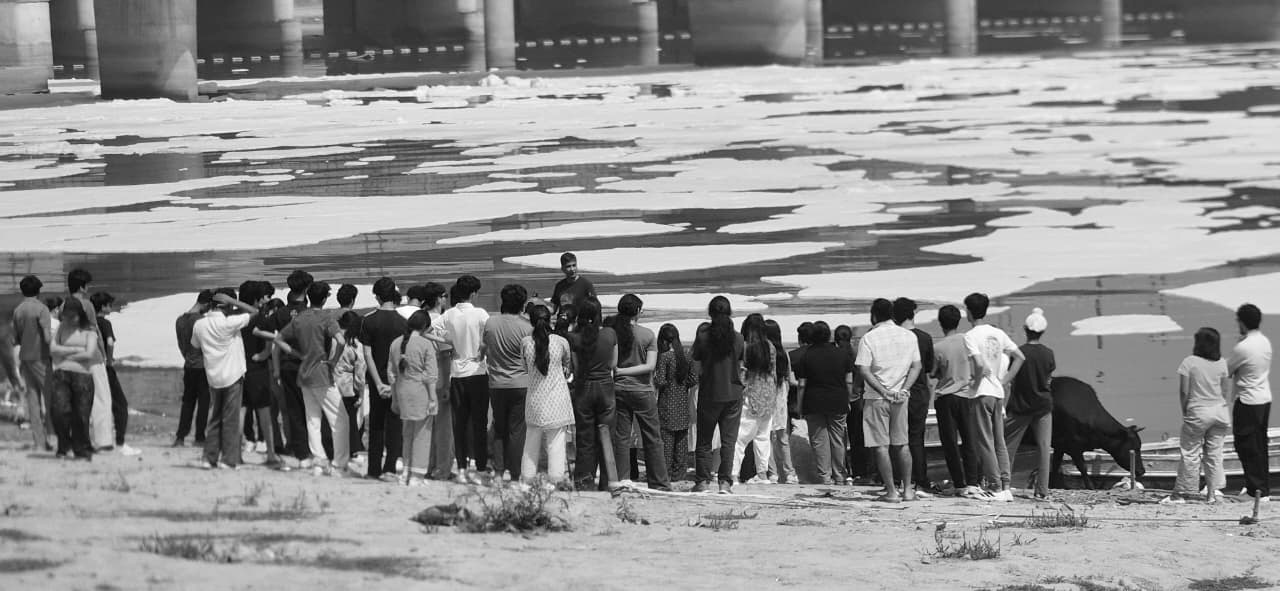
Delhi’s Yamuna
Every reading against its published limit. Every gap named.
Year round
PERIODIC — sampled on a cadence, not continuously
0.3 BDL
mg/L dissolved oxygen · the lowest the meter can report
No measurable oxygen
Legal minimum > 5.0 mg/L. Limit broken at 5 of 7 Delhi stations.
CPCB, 2025, at ISBT bridge and ITO bridge and 3 more. How this number is made.
What that means, in one line
A fish needs about four milligrams of oxygen in every litre of water to stay alive. The law asks for five. At 5 places in Delhi the instrument cannot find nought point three — and nought point three is not a measurement, it is the smallest number the method is able to print.
The government’s own word for it is BDL: below detection limit. Not low. Not measurable at all.
The river arrives alive and leaves dead, and it happens inside one city. At Palla, where the Yamuna enters Delhi, oxygen reads 5.4–9.8 mg/L. 6 stations later, at Okhla okhla, after the shahdara drain, it reads 0.3. The distance between those two readings is the length of Delhi.
Every other river
Before the rest of this page asks for your attention: the Yamuna is not an exception. It is the one Delhi has to look at.
Every river below is measured by CPCB against the same legal limit as the Yamuna: BOD under 3.0 mg/L. The bar is that river’s worst reading; the tick is the limit. Ranked by the worst single station, from 630 stations on 47 rivers.
The other 37 rivers in the table
This ranking cannot see the Yamuna in Delhi. The compiled table carries no Delhi Yamuna station, so the Yamuna's row below is computed without the stretch this page is about. CPCB's own Yamuna table puts the worst Delhi BOD at 72 mg/L. The ranking therefore understates this river, and the two numbers are shown together rather than one being swapped for the other — a ranking whose rows come from two different tables is not a ranking.
And a ranking of worst readings is a weaker claim than it looks. Each figure is a maximum, so a river with more stations has more chances to record a bad one. The station count is printed on every row. A river measured more is not a river polluted more. The last column is the station count for that reason.
CPCB measures the water. Nobody in that chain counts a person. These are the figures that do — from the World Health Organization, and they are for India as a whole, never for one river.
5,05,607
deaths a year attributed to unsafe water, sanitation and hygiene
36.4 per 100,000 x 1,38,90,30,312 people, both for 2019. WHO’s attributable-burden estimate, the most recent published. It is a model, not a count of certificates — WHO estimates what share of deaths from diarrhoea, respiratory infection and malnutrition is attributable to water and sanitation exposure.
76.4%
of India uses safely managed drinking water (2024)
Which leaves 23.6% who do not — on this population, around 35 crore people.
62.8%
uses safely managed sanitation (2024)
Sanitation is the upstream half of this whole page. What is not safely managed arrives somewhere, and for Delhi that somewhere has a name. Open defecation is down to 6.7%.
Counted or measuredModelled
It is not attributable to any one river. It is a national figure for unsafe water, sanitation and hygiene together, and no published figure isolates the Yamuna. It is a modelled attribution, not a count of death certificates. WHO estimates what share of deaths from diarrhoea, respiratory infection, malnutrition and other causes is attributable to WASH exposure. The rate is from 2019 and is the most recent WHO published. It is not this year's figure.
A page about a dead river is half the water story. When the surface fails, a city goes underground. This is the official annual account of what is left down there — from the same ministry that answers for the Yamuna.
92.1%
of Delhi’s annual groundwater recharge is taken back out every year
Delhi takes out 92 of every 100 litres its aquifers put back. Under 70% is classed Safe. Above 100% and the aquifer is being spent rather than used — the balance comes out of storage that does not come back.
Delhi’s 34 assessment units
21 of 34 are Critical or Over-Exploited (11 + 10). Seven are Safe.
How Delhi compares, and the national total
The tick is 100% — the line above which storage is being spent. Nationally the stage of extraction is 60.6%, and around 25% of 6,762 assessment units are Over-Exploited, Critical or Semi-Critical. Comparing states compares ratios, not volumes: Punjab at 156.4% and Delhi at 92.1% are different sizes of the same problem.
This is a correlation of two official assessments, not a causal claim. Delhi's groundwater is drawn down for many reasons, and this page does not assert that river pollution is one of them. What it asserts is only that both of the city's water sources are in the state their own regulators describe.
Sources. Rivers: CPCB National Water Quality Monitoring Programme data, as compiled by RiverWatch India. Health: WHO and the WHO/UNICEF Joint Monitoring Programme, via the World Bank’s open API. Groundwater: National Compilation on Dynamic Ground Water Resources of India, 2025, November 2025.
Who is in it
A dead river is not an aesthetic problem. It is a sanitation one, and it is the city’s own sewage that killed it.
3,596
million litres of sewage a day, Delhi
Delhi Jal Board’s own estimate, given to Parliament in July 2025. The city produces this every day, and it has to go somewhere.
1,582
million litres a day that reach the river untreated, or treated below the standard
44% of everything the city produces. 3596 generated - 2014 compliant. Both numbers are in the same paragraph of the same reply.
1.6 crore
faecal bacteria per 100 millilitres, at Okhla okhla, after the shahdara drain
A hundred millilitres is about a third of a glass. The legal limit is 2,500. This is 6,400 times it, and it is measured immediately after two of Delhi’s drains join the river.
Counted or measuredModelled
Read the last number again. It is not a pollution index or a score. It is a count of bacteria that come out of human bodies, in water that people stand in, wash in, immerse idols in and hold ceremonies beside — every week, at ghats along this stretch.
How the number is made
Four measurements, four published limits, and one of them is not really a measurement at all.
The Yamuna is judged on four things. All four limits come from the Primary Water Quality Criteria notified under the Environment (Protection) Rules, 1986 — and all four are printed in the header of the very table the readings come from. The measurement and the limit are on the same page of the same document. Nothing here had to be looked up, inferred or chosen.
Dissolved oxygen · legal minimum > 5.0 mg/L
Oxygen dissolved in the water, in milligrams per litre. It is the one measurement where a high number is good, and it is the closest thing to a pulse a river has. Below about 4 mg/L most fish cannot survive. Below 2, almost nothing can.
This is the number that reads 0.3. And 0.3 is the reporting floor of the method — the smallest value it can print. CPCB writes it as 0.3(BDL): below detection limit. The honest reading is “at or below 0.3”, and the honest word is not low but absent.
Biochemical oxygen demand · legal maximum < 3.0 mg/L
BOD measures how much oxygen the bacteria in the water would consume while eating what is dissolved in it. In plain terms: how much rot is in the river. A high BOD and a low oxygen are the same event described from two ends.
The worst Delhi reading is 72.0 mg/L at Okhla okhla, after the shahdara drain — 24 times the limit of 3.0. 7 of the 7 Delhi stations are over it.
Faecal coliform · legal maximum < 2500 MPN/100 mL
Bacteria that live in the guts of warm-blooded animals, counted per 100 millilitres. They are measured not because they are all dangerous but because their presence means sewage, and sewage carries what does the harm.
The count is expressed as MPN — most probable number — because the method is statistical rather than a headcount. 6 of 7 Delhi stations are over the limit, the worst by 6,400 times.
pH · legal range 6.5 – 8.5
How acidic or alkaline the water is. It is the one parameter on this page that Delhi mostly passes, and it is included for exactly that reason: a page that only shows the failures is not an instrument, it is an argument.
Every Delhi station in the 2025 table sits inside 6.5 – 8.5 or within a tenth of it. pH tells you almost nothing about whether a river is alive, which is why it is never the headline.
Source. National Water Quality Monitoring Programme — water quality data of river Yamuna, 2025 — the document, 33 stations from Yamunotri to Prayagraj, 7 of them in Delhi. Cross-checked against PROGRESS IN CLEANING OF YAMUNA RIVER — written reply in Lok Sabha, Lok Sabha Unstarred Question 1949, 31 July 2025.
The stretch
Seven monitoring stations, in the order the water passes them. 6 of the 7 are below the legal oxygen minimum.
measured BOD the legal limit, 3.0 mg/L · BDL = below detection limit · bacteria per 100 mL, limit 2,500
Look at the second row and the third. Between Wazirabad and ISBT bridge the oxygen falls from 3.4 to 0.3 and the bacteria count goes from 5,400 to 54 lakh. That is not a gradual decline down the length of a river. It is a cliff, and the city is standing at the top of it.
CPCB monitors Delhi's drains, but publishes them in a separate annual document from the river series above. So the collapse is measured in one report and the individual drains that cause it in another, and nobody publishes the two together.
Where it is going
The best answer available is six months long, and it is the same answer six times.
CPCB samples four Delhi stations monthly and the results were published in a written answer to Parliament in July 2025. This is the finest cadence that exists for this river — and it is the reason the page says PERIODIC and never LIVE. Each cell is the dissolved oxygen for that month.
Pallawhere the river enters Delhi
above the legal minimum in every month it was measured
Nizamuddincentral Delhi
below the detection limit in every month it was measured
Okhla barragewhere the river leaves the city
below the detection limit in every month it was measured
Asgarpur, after two drains joinimmediately after two of Delhi's drains join it
below the detection limit in every month it was measured
16 of the 21 monthly oxygen readings taken in Delhi in the first half of 2025 were below the detection limit. Not falling. Not seasonal. The same reading, every month, at every station downstream of the city.
Blank cells are blank in the source. March oxygen is missing at two stations and March bacteria at one, and they are left empty rather than carried forward from February or interpolated.
There is no machine-readable multi-year series for this river. CPCB republishes the same measurements in a different column layout every year.
So instead of a series, one check that survives any layout: the value against its own station name.
Two years apart, three stations, the same number — and that number is the floor of the method. Whatever has been done between those two readings has not moved this one.
Two points are not a trend, and a line between them would imply a rate this data cannot support.
How much the public looks up the Yamuna, month by month, measured as views of the English Wikipedia article. It measures attention, never water quality.
Peak 1,07,165 in Jul 2023 against a floor of 9,118 in Mar 2026 — a swing of 11.8×. The peak is the month the river flooded Delhi. The oxygen reading did not change in that month, or in any other.
A quiet month is not a clean month. Attention arrives when the river comes into the city, and leaves when it goes back inside its banks. The reading stays where it is either way. The current month is incomplete and is excluded from every figure here.
Where it comes from
Not factories. The city.
Every figure in this band comes from one paragraph of one parliamentary answer, and every derived figure shows its own arithmetic. Nothing is inferred beyond the subtraction shown.
519MLD
of treatment capacity built and not used
3474 installed - 2955 utilised. At the same time, 641 MLD of sewage goes into the river untreated. The idle capacity is 81% of the untreated flow. Delhi is not only short of plants. It is not using the plants it has.
14 of 37
sewage plants that fail Delhi’s own discharge standard
37.8% of the city’s working plants do not meet the limits set by Delhi’s own pollution control committee. A plant that runs and does not clean is counted as capacity.
941MLD
of sewage that IS treated, and still fails the standard
2,955 treated minus 2,014 compliant. Nearly a third of everything Delhi treats does not meet the standard it is treated to. This is the figure that sits between the two numbers usually quoted — it is neither the 641 MLD that never reaches a plant, nor the capacity that does. It is water that went through the process and came out failing.
And it is not industry. CPCB inspected 189 grossly polluting industries on the Yamuna’s main stem in 2024. Their total discharge was 1.3 MLD — against 641 MLD of untreated sewage. On the government’s own numbers, industry is roughly one five-hundredth of the problem in this river. That is worth saying plainly, because it is not what most coverage implies.
Of those 189, 158 were operating and 49 of those — 31% — were breaking their discharge conditions or had no valid consent. 40 received a show-cause notice and 9 were ordered shut.
Two sources, published as two
This page’s readings are CPCB’s. A second compiler, RiverWatch India, publishes a CPCB-derived station table with something CPCB’s own PDF lacks — coordinates. It is used for placement and never for a value, and its disagreements are printed rather than resolved.
On the stretch this page is about, the second source is silent: it carries no Palla, no Wazirabad, no ITO, no Okhla. That is why it is a cross-check and not a reading. Neither number is averaged into the other.
What has been spent
Nine projects. All of them finished. The oxygen has not moved.
₹1,951.03crore
sanctioned for sewerage work in Delhi under Namami Gange
1,268MLD
of treatment capacity it created
9of 9
projects completed
That is ₹1.54 crore for every million litres a day of capacity — 1951.03 crore / 1268 MLD. Separately, ₹140 crore was allocated for Yamuna cleaning from January 2025 by NMCG and the Delhi government, of which ₹108.3 crore — 77.4% — had been spent by the date of the reply.
All 9 projects, with cost and capacity
And the river it flows into
Delhi’s Yamuna work is one part of Namami Gange, the national mission for the Ganga basin. Without the national figure the Delhi figure has no scale.
₹35,698crore
taken up across 218 sewerage projects, basin-wide
3,977of 6,610 MLD
running, as of December 2025
60.2%
of the capacity paid for is switched on
138 of 218 projects are complete (63.3%), and 25 plants adding 530 MLD were commissioned during 2025 — 13.3% of everything now running. Alongside the sewerage: 33,024 hectares afforested along the Ganga for about ₹414 crore, and the first country-wide river dolphin assessment put the Gangetic dolphin population at 6,324. NAMAMI GANGE MISSION PHASE-II, 29 January 2026.
One division the release does not support. The release gives the cost of all 218 SANCTIONED projects and the capacity of the 138 COMPLETED ones. Those two figures do not divide into a meaningful cost per MLD, because the numerator and denominator describe different sets. Delhi's cost per MLD is computable only because its Yamuna reply gives cost and capacity for the same nine completed projects.
Completed is not the same word as working. What is on the record is that the capacity was built, the projects were signed off, and the oxygen at four Delhi stations still reads below the detection limit.
The widely circulated totals for money spent on the Yamuna — six and a half thousand crore, eight thousand crore — trace to newspapers reporting a parliamentary panel, not to the panel's own report. A figure reported by a newspaper is reporting, not data.
What is being said
100 items from 45 publishers, most recent first. Reporting is tagged as reporting. A headline is evidence that something was said, never that it is true.
Read the 40 most recent items
- Rs 8,941cr water projects to curb Yamuna pollutionThe Times of India · 19 Oct 2026
- Seven STPs eject contaminated discharge in Yamuna: DPCCThe New Indian Express · 20 Oct 2026
- Yamuna Clean-Up Projects Put Delhi’s Sewage System to the TestUrban Acres · 22 Oct 2026
- Ahead of Chhath Puja, Delhi CM joins drive to clear waste from Yamuna ghatsIndia Today · 18 Oct 2026
- MCD seals three unauthorised dhobi ghats in Old Delhi over Yamuna pollutionThe News Mill · 19 Oct 2026
- MCD seals 3 unauthorised dhobi ghats in Old Delhi to prevent polluted water from contaminating Yamuna RiverANI News · 19 Oct 2026
- Home Minister Amit Shah Launches ₹8,941DD News · 22 Oct 2026
- Delhi Plans Yamuna Riverfront On Sabarmati Model, Targets First-Phase Completion In Current Term: ReportSwarajyamag · 21 Oct 2026
- MCD seals three unauthorised dhobi ghats to curb Yamuna pollutionThe Statesman · 19 Oct 2026
- Crackdown On Yamuna Polluters In Delhi, 3 Illegal Dhobi Ghats SealedNDTV · 20 Oct 2026
- Yamuna’s Toxic Foam: Detergents, Sewage And The Failure To Clean Delhi’s RiverOutlook India · 22 Oct 2026
- Delhi Plans ₹8,941 Crore Water and Sewerage Push as Yamuna Cleanup Enters a New Phasewww.nationpathindia.com · 21 Oct 2026
- ‘Cleanliness is way of life’: Delhi CM Rekha Gupta leads Yamuna driveCityairnews · 18 Oct 2026
- Government invests ₹8,941 crore in sewage projects to curb Yamuna pollutionET Infra · 20 Oct 2026
- Three unauthorised dhobi ghats sealed in Old DelhiThe New Indian Express · 20 Oct 2026
- “All of Delhi must come together to ensure that Yamuna remains clean”: Task Force urges public participationANI News · 18 Oct 2026
- Delhi’s Yamuna Riverfront Plan Faces a Pollution TestUrban Acres · 20 Oct 2026
- Yamuna Pollution Claim Collides With Delhi’s 641 MLD Sewage GapUrban Acres · 20 Oct 2026
- Yamuna Cleanup: Why ₹8,000 Crore Has Not WorkedUrban Acres · 21 Oct 2026
- Delhi Congress slams ‘Chalo Yamuna’ drive, alleges failure to curb pollutionThe Tribune · 18 Oct 2026
- Delhi CM Rekha Gupta and Minister Parvesh Verma join Yamuna driveThe News Mill · 18 Oct 2026
- Yamuna more polluted in key stretches in Sept, despite monsoon rainThe Times of India · 12 Oct 2026
- Yamuna Clean-Up Expands Across 70 Delhi LocationsUrban Acres · 19 Oct 2026
- Delhi's Yamuna biologically dead: Fecal matter up, oxygen dips to zero in a yearIndia Today · 22 Jul 2026
- Dead fish found along Yamuna near Burari, industrial pollution flaggedThe New Indian Express · 16 Oct 2026
- Dead fish in Yamuna near Burari raise alarm over Delhi river’s water quality | India NewsHindustan Times · 15 Oct 2026
- 3 tons of waste removed from River Yamuna in 24 hours —How long would it take to clean the river?Moneycontrol.com · 24 Sep 2026
- Yamuna Pollution Worsens at Key Delhi Monitoring PointsUrban Acres · 13 Oct 2026
- Ganesh Puja done, Navaratri coming; is River Yamuna ready?The Federal · 30 Sep 2026
- Delhi HC Directs Immediate Measures to Curb Yamuna Pollution | SCC TimesSCC Online · 27 Aug 2026
- To stop untreated sewage entering Yamuna, Delhi to get 15 new decentralised treatment plantsThe Indian Express · 30 Jul 2026
- Pollution remains high in Yamuna, shows DPCC reportThe Times of India · 27 Jun 2026
- Can the Yamuna survive land-use change? Unchecked urban growth pushes Delhi's river to the brinkIndia Water Portal · 10 Jul 2026
- Yamuna pollution levels dip at some places; stay above permissible limitThe New Indian Express · 26 Jun 2026
- Striving for a day’s catch in the Yamuna on a monsoon morningDown To Earth · 28 Jul 2026
- To double sewage treatment capacity, Delhi Jal Board to start 18-20 new STPsThe Hindu · 06 Sep 2026
- Study flags cancer risk from Yamuna vegetablesThe New Indian Express · 24 Sep 2026
- In Delhi, the Yamuna gets polluted. In Bundelkhand, it is robbed of sandDown To Earth · 26 Jun 2026
- Environmentalists flag health of Yamuna, as river level remain low during monsoonET Infra · 28 Aug 2026
- World Environment Day: As Delhi's Water Crisis Deepens, The Yamuna Gasps For BreathETV Bharat · 05 Jun 2026
Publishers in the sample: The New Indian Express (11) · The Times of India (9) · Hindustan Times (9) · Urban Acres (6) · ANI News (4) · NDTV (4) · Down To Earth (4) · India Today (3) · The Indian Express (3) · The Hindu (3) · ETV Bharat (3) · The News Mill (2) · DD News (2) · Swarajyamag (2) · ET Infra (2) · CNBC TV18 (2) · South Asia Network on Dams, Rivers and People (2) · The Better India (2) · The Statesman (1) · Outlook India (1) · www.nationpathindia.com (1) · Cityairnews (1) · The Tribune (1) · Moneycontrol.com (1) · The Federal (1) · SCC Online (1) · India Water Portal (1) · Rediff (1) · ISKCON News (1) · Local Samosa (1) · Telegraph India (1) · Research Matters (1) · Deccan Chronicle (1) · Livemint (1) · Bar and Bench (1) · Nature (1) · Organiser (1) · The Economic Times (1) · Frontline Magazine (1) · Daily Pioneer (1) · Business Standard (1) · urbanacres.in (1) · The Cool Down (1) · OpIndia (1) · Jagran Josh (1)
What you can do
The river is downstream of a decision. Some of those decisions are yours.
Walk it
Swechha has run the Yamuna walk for two decades, and it is the single thing that changes how people talk about this river. You stand at the foam line. Nothing on a screen does that.
Ask one question
Your ward has a sewage connection or it does not, and a plant that meets the standard or one of the 14 that does not. Both are public. Ask which, in writing, and ask what the plan is for the 519 MLD of capacity already built and not used.
Stop sending it there
Idols, ashes, flowers, plastic and oil all arrive at the same water. It is the smallest of the causes on this page and the only one an individual fully controls.
Every figure on this page is public, dated and linked. If one is wrong, the source is named so you can prove it — which is the only kind of number worth publishing.
A gap is a gap
An empty day stays empty — a gap in the record is a gap in the record, never a zero.
Cite this page
Reuse freely — CC BY 4.0. Every figure carries its source and its cadence in how the number is made. If you quote a number from here, quote the kind with it. Each upstream source keeps its own terms.
This is what we are doing.
It is not enough.
The work against this reading
This organisation began as We for Yamuna in 2000 and the river is still its spine. Thirty Yatras since 2004 have walked over ten thousand young people from Yamunotri to Agra, and the Shramdaan days clean the bank in public.
And why it is not a reply
All of that is people, and the river’s problem is 1,582 MLD of sewage a day that reaches it without being treated to the standard. Clearing a bank does not put oxygen back in water. Dissolved oxygen at 0.3 mg/L against a legal floor of 5.0 is not a measure of how many turned up; it is a measure of what Delhi builds and then runs.
Understand the data
- Why is the Yamuna so polluted in Delhi?Twenty-two kilometres, most of the flow diverted, and the drains that replace it.
- What is dissolved oxygen?The single measurement that decides whether anything can live in the water.
- What is BOD?The oxygen a sample will consume in five days — the standard measure of organic pollution.
Once a month, what these numbers did.
One email. What the six readings did that month, what moved and what did not, and what we did about it. Nothing else, ever — no appeals between digests, and your address is never shared with anybody.
Confirm by email before anything is stored. Every message carries a one-click link to stop them.