
Swapnil Chaurasiya
←Bridge the Gap — Healthy Cities
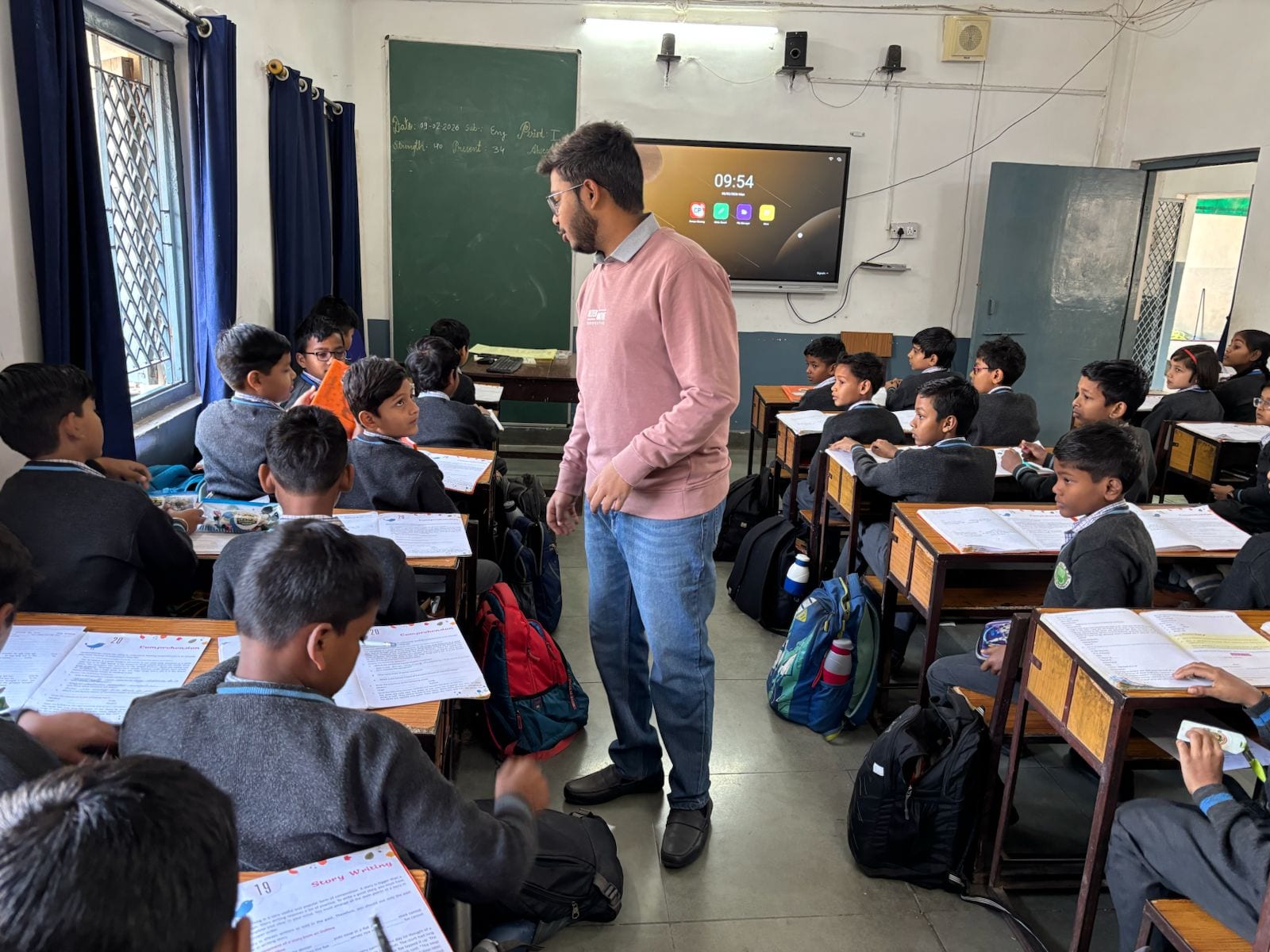
Behavioural Nudges for Urban Climate Action: A Student-Led Solid Waste Management Model for Bilaspur City
Bilaspur · Chhattisgarh · January to March 2026
Almost every child in Bilaspur already thought segregation was a good idea. Doing it at home went from 24 per cent to 80. The nudge was the child, working on the parent.
24% → 80%
Households segregating waste at home
before and after, January to March 2026
9% → 76%
Children reminding their families to segregate
before and after, January to March 2026
74%
Households that took up a two-bin system
after the intervention, March 2026
~90%
Parents reporting better waste practice at home
after the intervention, March 2026
The work
Move the practice, not the opinion
Ninety-seven to ninety-eight per cent of the children were already in favour of segregation at baseline. Approval was never the gap. The daily habit was.
Send the child home with the job
Checklists, bin labels, take-home tasks, and segregation built into Snakes and Ladders. The family gets reminded by the one person it cannot brush off.
Measure it properly or not at all
The same households surveyed before and after, on a questionnaire built around the theory of planned behaviour, so the result is a number rather than a feeling.
Keep it cheap enough to copy
Posters, labels, board games and one facilitator. A model a second ward can run without a budget line for it.
- Ran three to four school sessions with thirty-six children in Bilaspur
- Built a nudge toolkit of checklists, posters, bin labels and gamified learning
- Surveyed the same households before and after with structured questionnaires
- Reached thirty-five to forty households through the children and their parents
- Analysed the before and after results statistically rather than by show of hands
- Recorded two fathers’ accounts of what changed in their own houses in Bilaspur
The rest of the cohort
-
Bharuch · Gujarat
Anjali Choudhary
Maati Maange More
-
Mahuva, Dabhoi and Viramgam · Gujarat
Mansi Thakar Jani
Varso Jal Sanchay Initiative
-
Jabrella, Bharsaua and two further campuses · Uttar Pradesh
Palak Bajpai
Miyawaki Plantation Project
-
Chinthamani, Chikaballapura district · Karnataka
S Vineeth Kumar
Paradox Bio-Energy
-
Peth, Bubnal, Mangle and Kuslewadi, Sangli district · Maharashtra
Shubham Dipak Gurav
Climate Resilient Agriculture Initiative, Integrating Agroforestry and Natural Farming
-
Jhala, Harsil Valley and Saini, Dunda block, Uttarkashi · Uttarakhand
Shubham Panwar
Women-Led Sustainable Mushroom Cultivation for Nutrition and Livelihood in Rural Uttarkashi
-
Delhi
Taniya Gill
Rooted in Our Land: A Visual Toolkit on Native Plants and Climate Adaptation
-
Salmora and Karatipar, Majuli · Assam
Tanuz Kalita
Indigenous Youth Led Habitat Restoration for Climate Resilience in Majuli
-
Moradabad · Uttar Pradesh
Tawheed Zubair
ECONOVA (For Nature, For People)