
Anjali Choudhary
←Bridge the Gap — Healthy Cities
Maati Maange More
Bharuch · Gujarat · January to March 2026
Six hundred and seventy-seven people in Bharuch found out where their wet waste goes. Discarded chemical tanks became bulk composters, and one site now takes 180 to 200 kilos a day that used to leave for the landfill.
677
People sensitised
January to March 2026
40
Institutional staff trained
January to March 2026
10
Workshops held
January to March 2026
180–200 kg
Organic waste composted daily at one site
daily, by March 2026
The work
Compost where the waste is made
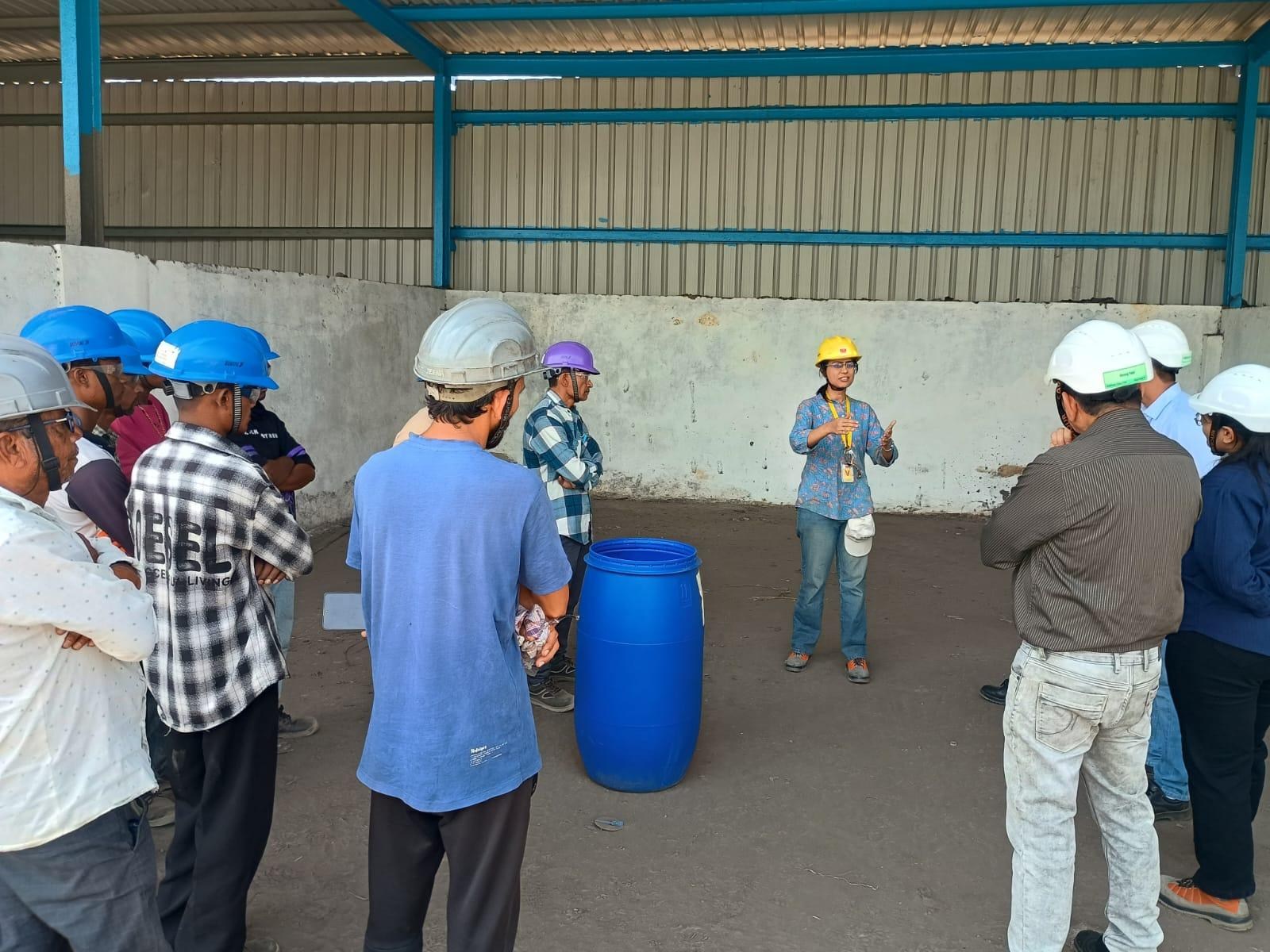
Schools, corporate campuses, an orphanage. The unit goes in on site, so the organic half of the bin never gets on a truck.
Teach whoever empties the bin
Students, self-help group women, housekeeping staff. Segregation is a habit held by the person handling it daily, not by the person who signs the policy.
Use what is already lying around
Discarded IBC tanks for bulk composting, a shredder for garden waste, microbes to speed it up, an earthen pot for the households who only need one.
- Ran sensitisation sessions for 539 school students across Bharuch
- Trained 98 women, including online sessions with rural self-help groups
- Installed composting units at two corporate campuses and a school
- Began a unit at an orphanage where sixty-five children had already been through the sessions
- Converted discarded IBC tanks into bulk composters and put a shredder on the garden waste
- Supplied compost accelerators and ran earthen-pot demonstrations for households
- Gave institutions the technical know-how to keep the units running themselves
- Elixir Foundation
- Jubilant
- Crest
- Aditya Birla
- Queen of Angels School, Bharuch
- Nikora School
What people said
Ms. Nirmala
“Need of the hour and how else students will learn about managing their own waste.”
Teacher at Queen of Angels School · Bharuch
The rest of the cohort
-
Mahuva, Dabhoi and Viramgam · Gujarat
Mansi Thakar Jani
Varso Jal Sanchay Initiative
-
Jabrella, Bharsaua and two further campuses · Uttar Pradesh
Palak Bajpai
Miyawaki Plantation Project
-
Chinthamani, Chikaballapura district · Karnataka
S Vineeth Kumar
Paradox Bio-Energy
-
Peth, Bubnal, Mangle and Kuslewadi, Sangli district · Maharashtra
Shubham Dipak Gurav
Climate Resilient Agriculture Initiative, Integrating Agroforestry and Natural Farming
-
Jhala, Harsil Valley and Saini, Dunda block, Uttarkashi · Uttarakhand
Shubham Panwar
Women-Led Sustainable Mushroom Cultivation for Nutrition and Livelihood in Rural Uttarkashi
-
Bilaspur · Chhattisgarh
Swapnil Chaurasiya
Behavioural Nudges for Urban Climate Action: A Student-Led Solid Waste Management Model for Bilaspur City
-
Delhi
Taniya Gill
Rooted in Our Land: A Visual Toolkit on Native Plants and Climate Adaptation
-
Salmora and Karatipar, Majuli · Assam
Tanuz Kalita
Indigenous Youth Led Habitat Restoration for Climate Resilience in Majuli
-
Moradabad · Uttar Pradesh
Tawheed Zubair
ECONOVA (For Nature, For People)