
Reading environmental data
What is a reporting floor?
A reporting floor is the lowest value a measurement method will return. Below it the method cannot distinguish one quantity from another, so it reports the floor. A reading at the floor therefore means at or below that value — never exactly it, and never zero. The same applies at the other end: a scale that saturates stops separating bad from far worse.
The instrument's edge, not the world's
Every measurement has a range. Outside it the number stops being a measurement and becomes a boundary.
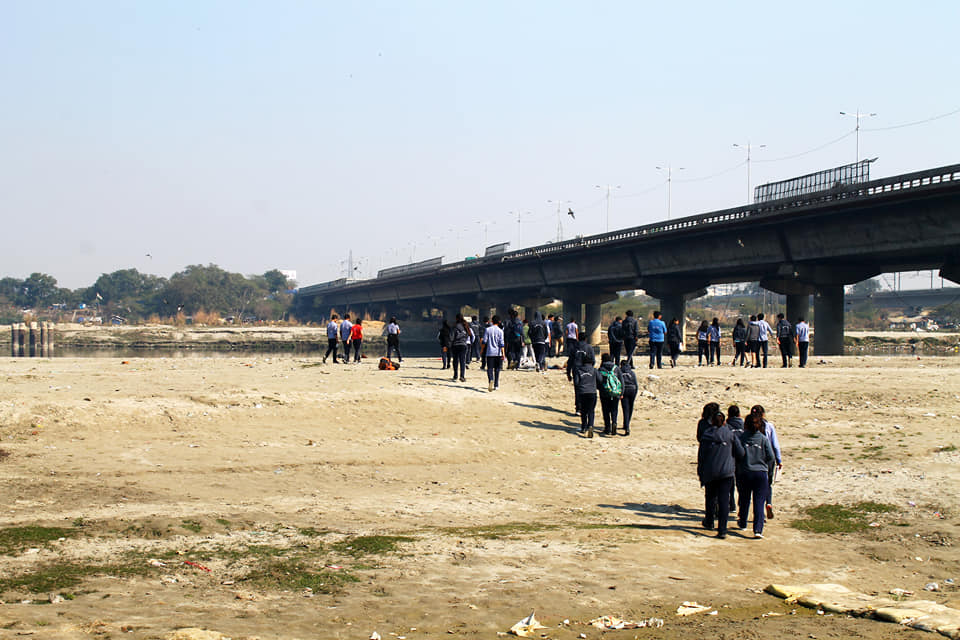
Below its detection limit an instrument still returns something — but what it returns is the limit, not the quantity. Four consecutive stations on the Delhi Yamuna report a dissolved-oxygen minimum of 0.3 mg/L, which is the floor CPCB's method reports. The true value at those stations is at or below 0.3, and it may be zero. Nothing in the data distinguishes the two.
Printing that as “0.3 mg/L” implies a precision the method does not have. Printing it as “0.0” invents a measurement nobody made. The honest reading is at or below — an instrument’s limit is not a measurement of nothing.
Ceilings behave the same way in reverse. India's Air Quality Index runs to 500, a figure chosen when concentrations above it were not expected to be routine. Delhi has reached it. When a station's sub-index saturates, the index has stopped distinguishing a bad evening from a far worse one, and the underlying concentration is the only thing that still can.
- Detection limit
- The lowest concentration a method can reliably find at all.
- Reporting floor
- The lowest value the method will actually publish. Often above the detection limit, and it is the one that appears in a dataset.
- Censored value
- The statistician's name for a reading known only to be above or below a bound. It cannot be averaged as though it were a point.
- Saturation
- The ceiling. Above it, differences stop being visible.
Two floors and one ceiling
Each of these is a property of a method, not of the environment it was pointed at.
Dissolved oxygen — CPCB reporting floor
0.3 mg/L
CPCB, National Water Quality Monitoring Programme
Nizamuddin — reported minimum
0.3 mg/L
CPCB NWMP 2025 — at or below
Okhla, after the Shahdara drain — reported minimum
0.3 mg/L
CPCB NWMP 2025 — at or below
For contrast — Yamunotri, well inside the range
11.2 mg/L
CPCB NWMP 2025 — a real measurement
Air Quality Index — top of the scale
500 AQI
CPCB National Air Quality Index, 2014
— and where the top band begins
401 AQI
CPCB National Air Quality Index, 2014
None of these is a limit anything can break. They are the edges of the instruments, and confusing an instrument's edge with a finding about the world is one of the commonest ways a dataset is misread — usually in the direction of making things look better than they are.
What to do with a censored value
Four rules, and the first one rules out most of what is usually done.
Do not average it. A set containing floor readings has no honest mean, because the values below the floor are unknown. Substituting zero, the floor, or half the floor are all common and all produce a different answer.
Do not plot it as a point. On a chart a floor reading is a bound; drawing it as an observation asserts a precision the method refused.
Do not read a run of floor readings as stability. Four stations at 0.3 mg/L look identical and may not be. The method has stopped resolving them.
Do say which it is. A dataset that publishes a floor is being honest with you; one that publishes zeros is not, and the difference is invisible unless somebody states it.
What it does not measure
- A floor reading cannot be converted into a real value. No amount of processing recovers information the method did not capture.
- It cannot be compared with a reading from a method with a different floor. Two datasets can disagree entirely because of where their instruments stop.
- A saturated ceiling cannot be extrapolated past. An index at its maximum is not a measurement of how far past the maximum the air went.
- None of this is detectable from the number alone. It requires the method's documentation.
Where this comes from
Every figure above comes from one of these.
- Water quality data of river Yamuna, 2025 Central Pollution Control Board, National Water Quality Monitoring Programme · The station minima and the 0.3 mg/L floor
- National Air Quality Index Central Pollution Control Board · The 0–500 scale and its top band
Reuse freely — CC BY 4.0. Each source above keeps its own terms.